
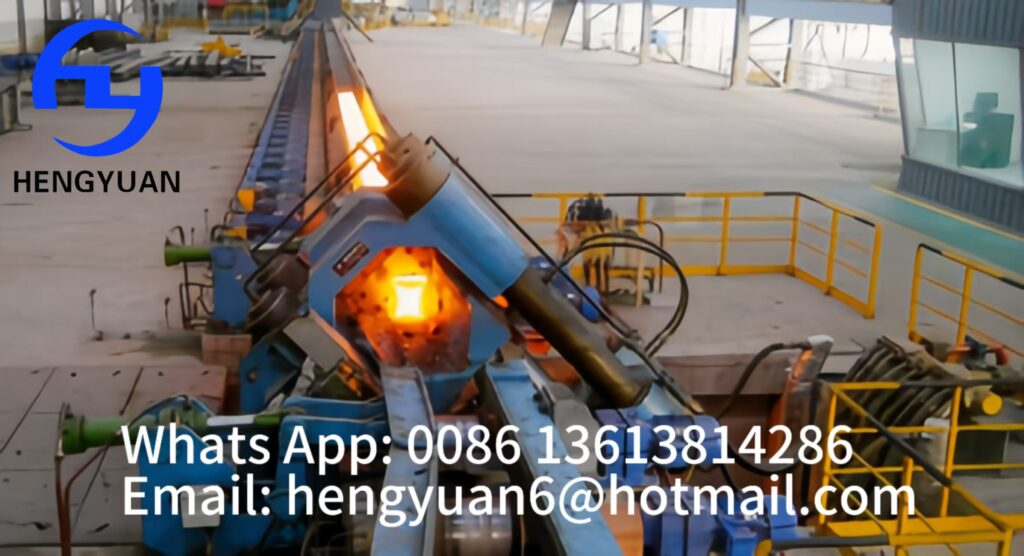
Against the backdrop of the global steel industry’s industrial upgrading and the ever-growing demand for high-quality special steel from high-end manufacturing, the blooming rolling process for special steel wire and bar has become a core link driving the high-quality development of long special steel products. It bridges the gap between large-section billets and downstream rolling procedures, and its technological innovation and optimized application are crucial to improving the quality, production efficiency and market competitiveness of special steel. Below is an in-depth analysis of the core driving factors, key processes, layout types and equipment selection of this technology, combined with industry development and practical applications.
I. Core Drivers for the Revival of Blooming Rolling Technology for Special Steel Wire and Bar
The renaissance of the blooming rolling process is an inevitable result of the combined effects of industrial policy requirements, high-end product quality demands and technological progress in continuous casting, and it is also a necessary choice for the production of high-end special steel worldwide:
- Dual Requirements of Industrial Policies and Production Efficiency
- Stringent Reduction Ratio Requirements for High-end Special Steel
- Technical Support from Continuous Casting Technology Upgrading
- Driving Force from Market Demand
II. Core Production Process: Premium Billet – Precision Rolling – Precision Finishing
The blooming rolling of special steel wire and bar follows the core process route of “Premium Billet – Precision Rolling – Precision Finishing”, covering the entire process of billet selection and preparation, heating, rolling and cooling, as well as online and offline finishing. Each link is designed around the quality requirements of high-end special steel.

(I) Billet Selection and Preparation: Adapting to Steel Grade Characteristics, Strictly Controlling Basic Quality
- Billet Type Selection
- For conventional special steel with large consumption such as high-quality carbon steel, alloy structural steel and spring steel, continuous casting rectangular billets (main choice) plus a small number of continuous casting round billets are preferred, taking into account production efficiency and yield.
- For special steel and high-value-added small-batch products such as steam turbine blade steel, high-speed tool steel, martensitic valve steel and nickel-based superalloy, ingot casting or electroslag remelting round ingots are adopted to ensure special performance requirements.
- Continuous Casting Billet Specification and Aspect Ratio Design
- Continuous casting rectangular billets are divided into medium and small sections (180×220~300×400mm) and large sections (319×410~580×680mm). The thickness limit of arc continuous casting rectangular billets is 420~430mm, and the maximum specification of continuous casting round billets can reach Ф1000mm.
- The aspect ratio should match the steel grade: 1.1~1.4 for high-carbon and high-alloy steel grades, and ≤1.25 for medium and low-carbon alloy steel such as gear steel (or round billets directly) to optimize the rolling deformation effect.
- Billet Pre-treatment
- High-carbon/high-alloy steel, martensitic stainless steel and other grades prone to cracking due to thermal or phase transformation stress, as well as alloy structural steel sensitive to hydrogen embrittlement prone to flaking, need to be cooled in slow cooling pits to release stress and promote hydrogen precipitation.
- In addition to manual surface inspection before heating, surface grinding is required for some high-end special steel to eliminate surface defects from the source.

(II) Heating, Rolling and Cooling: Adapting to Steel Grade Characteristics, Flexibly Selecting Rolling Processes
- Rolling Process Selection
- Core Rolling Procedures
- Cooling and Marking
- Rolled square billets (140×140~300×300mm) are cooled on walking beam cold beds, and slow-cooling billets are quickly transferred to slow cooling pits; U/V tooth electric tilting cold beds are used for single specification, and hydraulic adjustable pitch cold beds for multiple specifications to adapt to flexible production.
- Online marking (embossing/spraying/laser) is realized during cooling, marking heat number, steel grade and batch to achieve full-process traceability.
(III) Online and Offline Finishing: Eliminating Defects, Ensuring Billet Quality
One of the core values of blooming rolling is to expose internal/surface billet defects, and effective defect removal through precise finishing is the key to ensuring the quality of downstream rolled products:
- Defect Removal
- Stress Elimination and Flatness Improvement
- Full-process Quality Inspection
III. Main Rolling Line Layout Types for Blooming Rolling: Four Schemes for Diverse Production Demands
The layout type of the main blooming rolling line directly determines production capacity, product flexibility and investment cost. There are four mainstream types worldwide: single-stand reversing, double-stand reversing, semi-continuous rolling and full-continuous rolling, each with its own applicable scenarios, and semi-continuous rolling has become the mainstream due to its comprehensive advantages.

IV. Equipment Selection for Blooming Rolling Mills: Serialized Localized Equipment as the Mainstream
Blooming rolling mills are the core equipment of blooming rolling lines. After decades of technological iteration and industrial application worldwide, housing-type blooming mills and housingless short-stress path rolling mills have become the mainstream. The two types of mills have their own characteristics, and their optimized combination can meet the process requirements of different layout types, while traversing blooming mills provide more options for small special steel blooming lines.
(I) Characteristics and Selection Principles of Two Mainstream Mill Types
- Housing-type Blooming Mill Core Advantages: Closed housing structure with hydraulic axial locking of rolls, small axial movement; equipped with electromechanical integrated upper roll screw down device, automatic anti-jamming mechanism and automatic billet turning/transfer devices at the front and rear, realizing automatic roll groove alignment and automatic pass reduction, suitable for working conditions with large axial force and reciprocating reversing rolling, the first choice for main blooming mills. Serialization: Covering a wide range of specifications (Ф650~1450mm), with mature application and stable performance, it is the core equipment for large reduction blooming rolling.
- Housingless Short-stress Path Rolling Mill Core Advantages: Integrated replacement of mill stand and guide, pre-adjustable roll groove and guide between rolls, greatly reducing online adjustment time; vertical-horizontal alternate arrangement with high rolling precision, suitable for subsequent rolling of continuous rolling mills. Limitations: Excessively large models will lead to bulky vertical mill lifting/locking mechanisms and high hoisting weight, increasing investment costs, so the maximum model specification needs to be controlled. Serialization: Covering a full range of specifications (Ф300~1100mm), with a large number of applications, it is the key equipment for high-precision continuous rolling.
- Optimal Combination: The combination of housing-type blooming mill + housingless short-stress path rolling mill combines the large reduction capacity of reversing blooming rolling and the high precision of continuous rolling, which is the best equipment selection for semi-continuous blooming rolling production process.

V. Development Trends and Industrial Value of Blooming Rolling Technology for Special Steel Wire and Bar
The continuous development and innovation of blooming rolling technology for special steel wire and bar is an inevitable trend of the global special steel industry moving towards high quality and high added value, and its industrial value and development trends are reflected in three aspects:
- Technological Serialization and Localization
- Process Flexibility and High Efficiency
- Full-process Quality Control Centered on Product Quality
As a key link in the production of long special steel products, the continuous innovation and optimization of blooming rolling production technology will further drive the global special steel industry to develop towards high quality and high added value, and provide higher-quality raw material support for downstream industries such as machinery, automotive and high-end equipment manufacturing worldwide.