
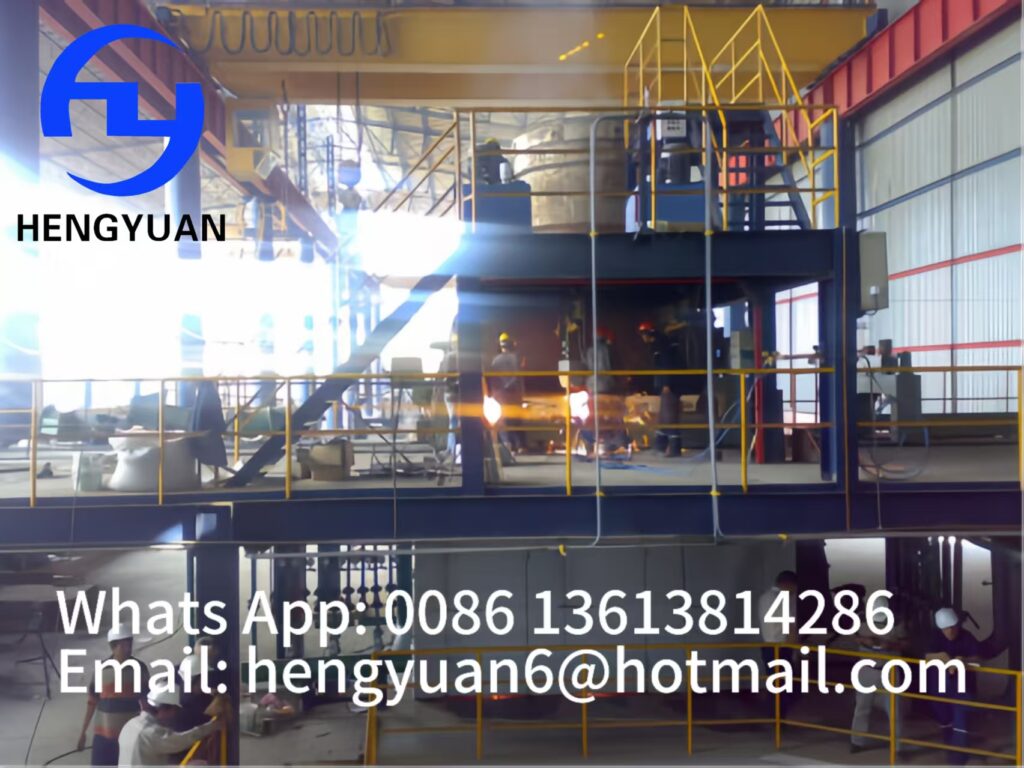
In the ever-evolving steel manufacturing landscape, the pursuit of higher efficiency, better product quality, and lower operating costs has become the core goal of enterprises worldwide. For steel plants focused on billet production, a reliable and advanced continuous casting machine is not just equipment—it’s a strategic asset that determines production capacity, product competitiveness, and long-term profitability. Today, we delve into a high-performance R8.0m two-strand billet continuous casting machine that integrates cutting-edge technology, robust design, and intelligent control, redefining the standards for modern billet production.
I. Core Design Philosophy: Balancing Efficiency, Stability, and Quality
The design of this continuous casting machine adheres to four core principles: advanced technology, practicality, reliability, and economy. Every component and system is engineered to address the pain points of traditional casting equipment—such as unstable operation, high defect rates, frequent maintenance, and low production efficiency—while meeting the demands of large-scale, high-standard production.
- Integrated Structural Layout: The entire machine adopts a compact and reasonable layout, with key equipment such as the ladle turret, tundish car, mold, and straightening and withdrawal unit optimally positioned. This not only reduces the occupied plant area but also shortens the molten steel flow path, minimizing temperature loss and improving casting stability.
- Low-Center-of-Gravity Design: The rolling mill’s low center of gravity and small tipping moment ensure minimal vibration during operation. Combined with a lightweight pressing device, this design significantly reduces lateral displacement and deformation, laying a solid foundation for high-precision billet forming.
- Modular & Maintainable Structure: Key on-line equipment can be hoisted as a whole for offline maintenance, avoiding long production downtime caused by on-site repairs. The simple and practical structural design also lowers the threshold for daily maintenance, reducing labor intensity for maintenance teams.

II. Key System Breakdown: Technological Advantages Behind Stable Operation
1. Molten Steel Conveying & Distribution System: Precise Control from Ladle to Mold
The molten steel conveying process is critical to ensuring casting quality, as any instability can lead to billet defects such as inclusions or uneven composition. This continuous casting machine is equipped with a high-performance molten steel handling system to ensure smooth and precise distribution.
- Ladle Turret: Designed with a single-side load capacity of 50t, the turret features dual hydraulic motor drive (with emergency drive backup) and stepless speed regulation (1rpm). It can smoothly rotate the ladle from the receiving position to the casting position, enabling multi-heat continuous casting. The integrated weighing system and insulation cover further ensure molten steel quality and stable pouring.
- Tundish & Tundish Car: The T-type tundish (nominal capacity ~6t) is computer-optimized for minimal temperature drop, ensuring uniform molten steel temperature and fluidity when entering the mold. The tundish car adopts a Z-shaped frame with high and low legs, double drive, and manual transverse fine-tuning (50mm stroke) for precise nozzle alignment. Its heat-resistant structure completely isolates the impact of molten steel thermal radiation, ensuring safe and reliable operation.
- Trough & Baking Device (Optional): The bending-welded trough guides molten steel to the slag box during initial casting or accidents, protecting the mold from damage. The optional cantilever tilting tundish baking device heats the tundish lining to ~1000℃ in 60 minutes, ensuring optimal molten steel pouring conditions and reducing cold shut defects.
2. Mold & Vibration System: The “Heart” of Billet Forming
The mold is the core component of continuous casting, responsible for the initial solidification of molten steel into billets. This machine’s mold and vibration system are engineered to maximize billet surface quality and dimensional accuracy.
- Narrow-Gap Water Jacket Mold: Made of phosphorus-deoxidized copper with a parabolic arc tube design, the mold features a 4.5mm narrow water gap and 12m/s high water speed. This structure effectively avoids local boiling of cooling water, ensuring uniform heat dissipation and rapid formation of a stable billet shell. The 900mm-long mold and integral stainless steel inner water jacket further enhance rigidity and cooling efficiency, reducing corner cracks and off-square defects.
- Integral Vibration Device: Adopting European advanced integral vibration structure (replacing traditional spring plates), the device ensures stability at high frequencies and prolongs service life. The vibration frequency (20~320 l/min) is automatically adjusted by PLC according to the drawing speed, maintaining an optimal negative slip rate. With adjustable amplitude (2~4mm), it adapts to different steel grades and casting speeds, improving billet surface quality by reducing oscillation marks.
3. Secondary Cooling & Straightening System: Ensuring Full Solidification & Precision Straightening
After leaving the mold, the billet (with only a thin shell) requires precise cooling and straightening to avoid internal cracks and deformation. This machine’s secondary cooling and straightening system work in tandem to ensure billet quality.
- 4-Section Secondary Cooling Spraying System: The system consists of Section O (foot roller strong cooling) and Sections Ⅰ~Ⅲ (precise spray cooling), with independent flow meters and automatic regulating valves for each section. The stainless steel spray pipes deliver uniform water distribution, and the flow rate is dynamically adjusted based on casting speed and steel grade. This ensures rapid and uniform thickening of the billet shell, preventing internal segregation and shrinkage defects. An automatic backwash filter is also equipped to reduce nozzle clogging, ensuring stable cooling effect.
- Five-Roll Three-Drive Straightening and Withdrawal Unit: As a core component, the unit features an integral frame and internal water-cooled structure (straightening rollers, bearing seats, reducer, and motor). The three-drive design provides sufficient traction force, while the hydraulic cylinder-controlled pressure conversion (hot/cold billet) ensures gentle and precise straightening. The heat shield made of stainless steel pipe further enhances durability. With a speed range of 0.3~4.5m/min, it adapts to different casting stages, from tundish bar feeding (4.5m/min fast speed) to normal billet drawing.

4. Cutting & Conveying System: Efficient Finishing & Smooth Logistics
After straightening, the billet needs to be cut to fixed lengths and conveyed to the cooling bed, a process that directly affects production efficiency and billet storage.
- 45° Hydraulic Shear: With a shear force exceeding 350T and a cutting cycle of ~18s, the shear adopts a 45° diagonal cutting design for smooth cuts and minimal billet deformation. Controlled by PLC, it achieves precise fixed-length cutting (6.0m standard, customizable) and works seamlessly with the conveying system. The billet temperature requirement (>800℃) ensures cutting efficiency and quality.
- Multi-Stage Conveying Roller Table: The system includes pre-shear, post-shear, and terminal roller tables, all with internal water-cooled bearing seats and centralized chain drive. The roller linear speed (~30m/min) matches the casting and cutting speed, ensuring smooth billet transportation. The terminal roller table (2500mm roller length) and buffer baffle accurately position the billet for subsequent transfer.
- Elevated Transverse Billet Transfer Car: This car translates billets from each strand to the cooling bed with a moving speed of 20m/min and a moving distance of ~7.5m. Equipped with 4 shifting claws, it handles 100×100~200×200mm billets (6.0m length) and arranges them unidirectionally, improving cooling bed utilization and subsequent stacking efficiency.

5. Hydraulic, Cooling & Electrical Control Systems: The “Nervous System” Ensuring Stable Operation
Behind the efficient operation of the continuous casting machine is a set of reliable auxiliary systems that provide power, cooling, and intelligent control.
- Hydraulic System: Equipped with an independent pump source (one for use, one for standby) and accumulator, the system drives key components such as the ladle turret hydraulic motor, straightening and withdrawal cylinder, and shear cylinder. With a rated pressure of 31.5MPa, it ensures sufficient power and stable operation. Key valves (solenoid valve, electro-hydraulic directional valve) are sourced from well-known manufacturers for high reliability.
- Three-in-One Cooling System: Mold cooling (closed circuit): Inlet pressure ≥1.2MPa, temperature ≤35℃, flow rate ≥360m³/h, with pressure alarm to prevent mold explosion due to water shortage. Secondary cooling (open circuit): Inlet pressure ≥1.0MPa, impurity particle size ≤0.2mm, flow rate ≥60m³/h, ensuring precise cooling control. Equipment cooling (open circuit): Inlet pressure ≥0.4MPa, impurity particle size ≤0.5mm, flow rate ≥120m³/h, cooling key equipment such as the straightening and withdrawal unit and hydraulic shear to prolong service life.
- Intelligent Electrical Control System: Adopting Siemens S7-1200 PLC, the system is divided into common control stations and strand-specific control stations, ensuring independent operation of each strand (no mutual interference in case of failure). The man-machine interface allows real-time monitoring and modification of secondary cooling water distribution, vibration frequency, and other parameters. Frequency converters (Siemens) and contactors (Schneider) ensure stable speed regulation and electrical control. The centralized layout of electrical cabinets (main control room) and hanging operation boxes (beside the mold) simplifies operation and maintenance.

III. Key Performance Indicators: Tangible Production Advantages
The true value of equipment lies in its actual production performance. This R8.0m two-strand billet continuous casting machine delivers impressive indicators that directly translate to enterprise benefits:

IV. What This Equipment Brings to Your Enterprise
Investing in this R8.0m two-strand billet continuous casting machine is not just a purchase—it’s an investment in long-term development. Here are the tangible benefits it brings:
1. Improve Production Efficiency & Capacity
- Full-process automation reduces manual intervention, shortening the production cycle. The fast casting preparation time (27 minutes) and high operation rate (82.2%) ensure continuous and efficient production.
- The maximum drawing speed of 3.5m/min and two-strand design significantly increase hourly output, helping enterprises meet large-order demands and expand market share.
2. Enhance Product Quality & Reduce Defects
- Precise control systems (PLC-adjusted vibration frequency, automatic secondary cooling water distribution) and advanced mold design ensure uniform billet solidification and dimensional accuracy.
- The 4-section secondary cooling system and narrow-gap water jacket mold reduce billet defects such as corner cracks, off-square, and internal segregation, improving the qualified rate and market competitiveness of products.
3. Lower Operating & Maintenance Costs
- Key components adopt internal water-cooled structures and three-stage sealing design (metal sealing + two-stage dust sealing), prolonging bearing service life and reducing maintenance frequency.
- The built-in annular damper is impact-resistant and pollution-resistant, lowering failure rates and maintenance costs. The modular design allows offline maintenance, reducing production downtime.
- High billet yield (96%) reduces material waste, while energy-saving design (reasonable power distribution, efficient cooling) lowers energy consumption.
4. Strong Adaptability & Future-Proofing
- The casting section (100~200mm square) covers multiple specifications, adapting to different market demands. It supports both new plant construction and old line renovation.
- The advanced electrical control system and modular structure allow for future upgrades and expansions, ensuring the equipment remains competitive in the long term.
V. Who Can Benefit From This Equipment?
This continuous casting machine is tailored for:
- Steel plants specializing in billet production (Q235, 20MnSi, etc.)
- Enterprises planning new steelmaking and continuous casting workshops
- Plants looking to upgrade old continuous casting lines for higher efficiency and quality
- Manufacturers targeting large-scale production and cost optimization
In the fiercely competitive steel industry, choosing the right equipment is the first step to success. This R8.0m two-strand billet continuous casting machine integrates advanced technology, stable performance, and cost-effectiveness, helping enterprises break through production bottlenecks, improve product quality, and achieve sustainable development.
If you are looking for a reliable continuous casting solution to enhance production capacity, reduce costs, or upgrade your production line, we welcome you to connect and communicate. Our team of experts can provide customized technical support and solutions based on your specific needs—whether it’s adjusting parameters for different steel grades, optimizing layout for your plant, or providing after-sales training and maintenance guidance.
Let’s work together to build a more efficient, stable, and high-quality steel production line. Your next production upgrade starts here!