
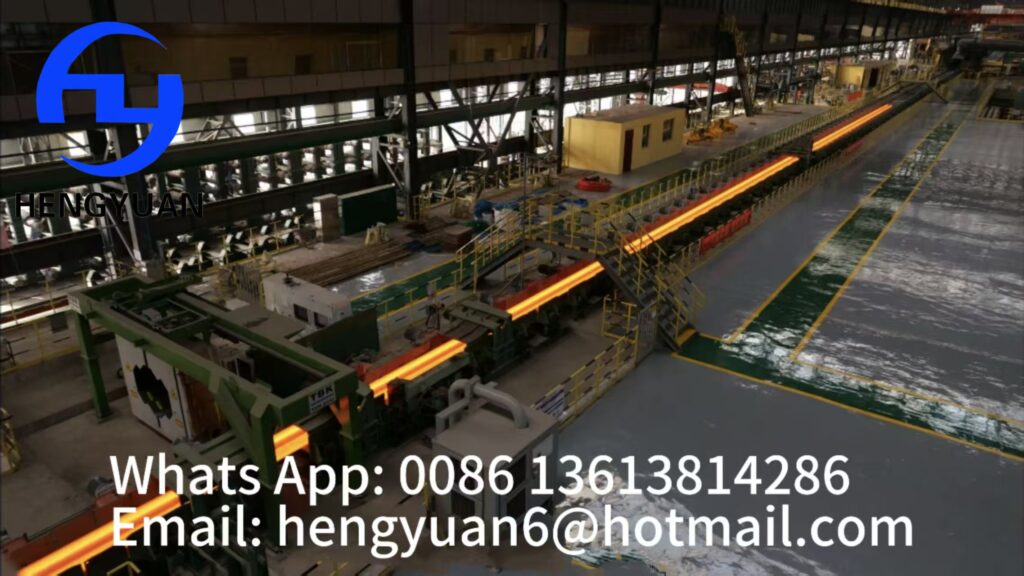
In the global steel industry, hot rolling and cold rolling are far more than just two processing methods—they are the foundational pillars of every high-performance steel product, from structural beams for skyscrapers and heavy rails for high-speed railways to precision sheets for aerospace and medical implants. As a leading supplier of rolling mill production lines, equipment, and turnkey solutions, we understand that mastering these two processes is the ultimate key to unlocking operational efficiency, consistent product quality, and long-term profitability for your mill. Let’s break down their core mechanisms, key differences, industrial applications, and how our expertise can solve your most pressing production challenges.
1. Hot Rolling: The “Workhorse” of High-Volume, High-Strength Production
Hot rolling is the first critical step in transforming raw steel billets, ingots, or slabs into usable semi-finished products. It takes place at extremely high temperatures—typically 1100–1250°C for carbon steel, and ~900–1000°C for α+β titanium alloys—well above the material’s recrystallization temperature. This extreme heat softens the metal, making it ductile enough to withstand extensive deformation, much like kneading warm dough to shape it into any form.
Key Advantages of Hot Rolling
✅ Unmatched productivity & cost efficiency: Hot rolling enables one-step forming with massive deformation capacity, making it ideal for large-scale, high-volume production of structural steel (I-beams, channels, angles), heavy sections, railway rails, steel piles, and thick plates. The process minimizes production steps and energy consumption per ton of steel, delivering the lowest possible cost for structural and heavy-duty applications.
✅ Eliminates internal material defects: The high-temperature rolling process effectively “welds” closed internal pores, micro-cracks, and chemical segregation in the raw steel ingot, significantly improving the material’s overall density, structural integrity, and mechanical consistency. This is why hot-rolled steel is the trusted choice for load-bearing structural components.
✅ Superior formability for complex shapes: The softened, ductile metal allows for complex profile rolling and large reductions in thickness without cracking, making it the only viable option for large-diameter bars, heavy-section beams, and custom-shaped pile products used in construction and infrastructure.
✅ Natural corrosion resistance for outdoor use: The thin oxide scale formed on the surface during hot rolling provides basic rust protection, making hot-rolled steel suitable for outdoor storage and structural applications without immediate surface treatment.

Core Technical Challenges & Our Solutions
Hot rolling’s biggest challenge lies in balancing temperature, deformation, and microstructure to avoid defects and ensure consistent quality. We solve these pain points with tailored mill design and process control:
- Precision temperature window control: For alloy steels and titanium alloys, rolling temperature must be strictly controlled near the material’s transus point. Too high causes grain coarsening and oxidation; too low leads to excessive deformation resistance and cracking. Our rolling lines are equipped with closed-loop temperature monitoring and heating systems, ensuring stable temperature control throughout the process. For example, TC4 titanium alloy is optimized at 900–950°C to balance plasticity and dynamic recrystallization.
- Dynamic recrystallization (DRX) optimization: DRX is the core mechanism for grain refinement during hot rolling, driven by deformation energy. Our control systems fine-tune strain rate, finishing temperature, and alloy composition to trigger full DRX, refining grain size and boosting material strength by up to 30% compared to traditional processes. In near-α titanium alloy TA16 production, we achieved a 2.6μm ultra-fine grain structure with 30% higher strength via controlled DRX.
- Multi-pass deformation consistency: Industrial hot rolling often involves continuous multi-pass deformation (e.g., reducing 180mm billets to 14mm wire rods with 90% total deformation), which creates temperature gradients and uneven microstructure. We implement near-isothermal rolling technology to stabilize the temperature field, eliminate surface-to-core grain size differences, and ensure uniform mechanical properties across the entire section.
- Residual stress management: Natural air cooling after hot rolling can leave residual internal stress. We integrate controlled cooling systems (such as laminar cooling) into our lines to regulate cooling rates, minimize residual stress, and prevent warping or dimensional instability in finished products.
2. Cold Rolling: The “Artisan” of Precision, Surface Quality & High Strength
Cold rolling is the secondary processing step that elevates hot-rolled steel to high-value, precision products. It takes pickled hot-rolled coils as raw material, processing them at room temperature (well below the recrystallization temperature) to achieve ultra-fine dimensional accuracy and superior surface finish. The process induces work hardening, which can be tailored via post-rolling annealing to balance strength and ductility.

Key Advantages of Cold Rolling
✅ Ultra-high precision & mirror-like surface finish: Cold-rolled steel has a smooth, oxide-free, mirror-bright surface, with dimensional accuracy far exceeding hot-rolled products. Thickness can be reduced to 0.1mm or less—thinner than a sheet of paper—making it perfect for automotive body panels, home appliance shells, electronic components, and medical devices where surface quality is non-negotiable.
✅ Significant work hardening for high strength: Cold rolling drastically increases dislocation density in the steel (from 10¹⁰ m⁻² to 10¹⁵ m⁻²), with dislocations interacting to block further movement and boost strength. For example, pure titanium (TA2) sees its yield strength jump from 200MPa to 400MPa after cold rolling, while elongation adjusts from 50% to 10%.
✅ Controlled texture & anisotropy for formability: Cold rolling aligns grain orientation (texture) in the material. We can tailor the rolling process to optimize texture, ensuring excellent formability for deep drawing, stamping, and complex forming operations. For HCP-structure α-titanium, we control basal plane slip to form {0001} basal texture, while BCC β-titanium forms {110} fiber structure for targeted performance.
✅ Stress-induced phase transformation for specialty alloys: For high-strength β-titanium alloys and other specialty materials, cold rolling triggers stress-induced martensitic transformation, further enhancing strength while maintaining ductility. In medical β-titanium alloy TNTZF, 60% cold reduction achieves 40% higher strength with 15% retained elongation, ideal for orthopedic implants.
✅ Consistent mechanical properties: Post-rolling annealing eliminates internal stress, restores ductility, and stabilizes the microstructure, ensuring consistent performance across every batch of cold-rolled product.
Core Technical Challenges & Our Solutions
Cold rolling requires precise control of deformation, work hardening, and post-processing to avoid brittleness, cracking, or dimensional errors. Our solutions address these critical pain points:
- Work hardening & ductility balance: Cold rolling increases strength but reduces ductility. Our cold rolling lines are fully integrated with online continuous annealing systems, allowing us to precisely control annealing temperature and time to eliminate internal stress, restore ductility, and achieve the perfect balance of strength and formability for your application.
- Texture optimization & anisotropy reduction: Uncontrolled texture causes anisotropy (directional property differences), leading to uneven forming performance. We design custom cross-rolling processes and roll pass schedules to randomize grain orientation, reduce anisotropy, and ensure consistent mechanical properties in all directions for critical applications.
- Phase transformation control for high-strength alloys: For specialty alloys, we precisely control cold reduction rate, rolling speed, and temperature to manage stress-induced phase transformation, achieving targeted strength and ductility combinations without sacrificing material performance.
- Surface quality & dimensional consistency: Our cold rolling mills are equipped with high-precision hydraulic AGC (Automatic Gauge Control) systems, real-time surface inspection, and tension control, ensuring ±0.001mm thickness accuracy and defect-free surfaces for high-end applications.
3. Hot vs. Cold Rolling: A Comprehensive Comparison for Your Production
To help you select the right process for your product line, here’s a detailed side-by-side comparison of their core characteristics:

4. Synergistic Hot + Cold Rolling: The Ultimate Solution for High-End Steel Production
For most high-value steel and alloy products, a combined hot + cold rolling process is the industry standard, leveraging the strengths of both methods to deliver superior performance:
- Aerospace titanium alloy sheets: Hot rolling first reduces large ingots to intermediate slabs, refining grain size via dynamic recrystallization and eliminating defects. Cold rolling then reduces thickness to final specifications, boosting strength via work hardening. Final annealing restores ductility, resulting in sheets with 1200MPa yield strength and 15% elongation, perfect for aircraft structural components.
- Medical titanium wires: Multi-pass cold rolling (80% total deformation) induces stress-induced martensitic transformation, increasing tensile strength from 800MPa to 1200MPa. Subsequent aging treatment decomposes martensite, precipitating fine α-phase to improve ductility from 10% to 18%, ideal for orthopedic implants and surgical tools.
- Automotive high-strength steel: Hot rolling produces a uniform, defect-free base material, while cold rolling adds strength via work hardening. Controlled annealing creates a dual-phase microstructure, delivering high strength for crash safety and excellent formability for complex body panels.
As your rolling mill partner, we design fully integrated hot + cold rolling lines that seamlessly connect these processes, ensuring consistent quality and maximum efficiency from raw material to finished product.

5. Why Partner With Us for Your Rolling Mill Needs?
As a professional supplier of rolling mill production lines, spare parts, and turnkey solutions, we don’t just sell equipment—we deliver end-to-end technical expertise to solve your production bottlenecks and elevate your mill performance:
🔧 Customized line design for your product mix: We tailor hot rolling lines for heavy sections, railway rails, steel piles, and titanium alloy hot rolling, and cold rolling lines for precision sheets, wires, and specialty alloys, matching your capacity, product range, and quality requirements.
⚙️ Full-process technical support: Our engineering team provides on-site guidance for temperature control, dynamic recrystallization, work hardening, phase transformation, and cold/hot saw operation optimization. We help you refine cutting speed calculations (cm²/s vs cm³/s), feed rate settings, and per-tooth material removal to maximize saw blade life and cut quality.
📊 Lifecycle equipment service: From equipment installation, commissioning, and worker training to regular maintenance, spare parts supply, and technical upgrades, we ensure your rolling line runs at peak efficiency for decades.
🤝 Proven global customer success: We have served steel mills across the Middle East, Europe, Southeast Asia, and beyond, with deep expertise in rail, heavy section, and specialty alloy production lines. Our technical team personally visited Suez Steel’s production facility in January, gaining first-hand insight into your rail, heavy section, and pile production challenges.
💡 Continuous process innovation: We stay at the forefront of rolling technology, integrating Industry 4.0 automation, AI process optimization, and energy-saving systems into our lines to help you reduce production costs and meet global sustainability standards.
6. Let’s Elevate Your Rolling Mill Performance Together
Whether you are looking to upgrade your existing hot rolling line for higher productivity, build a new cold rolling line for high-value precision products, solve technical bottlenecks in titanium alloy rolling, or optimize your cold/hot saw operations, our team of metallurgical engineers and mill experts is ready to support you.
We understand the unique challenges of rail, heavy section, and pile production, and we can provide customized solutions tailored to your mill’s specific needs. Reach out to us via WhatsApp at 008613613814286 to schedule a technical consultation, share your production challenges, and explore how we can help you build a more efficient, profitable, and future-ready rolling production line.