
In today’s steel industry, production efficiency, workplace safety, and product consistency are no longer optional—they are essential. For mills running angle steel, channel steel, flat bar, and other profiles, the finishing section has long been a critical bottleneck.
High-temperature materials, heavy loads, repetitive heavy lifting, manual sorting, alignment, palletizing, and strapping have created ongoing challenges: fluctuating efficiency, inconsistent bundle quality, high labor turnover, safety risks, and recruitment difficulties.
Over recent years, integrated robotic palletizing systems have emerged as a reliable, practical solution. These systems are not about replacing labor simply for cost savings; they are about stabilizing processes, improving quality, reducing risk, and making entire production lines more sustainable and competitive.
For teams evaluating automation options, understanding how these systems work and what value they truly deliver can make project planning much clearer.

Why Manual Palletizing Is Becoming Unsustainable
Before automation, nearly every section steel line faced similar pain points:
- High-temperature profiles (around 70°C) create harsh working environments
- Heavy, long profiles lead to physical fatigue and safety risks
- Manual alignment and stacking result in messy, uneven bundles
- Efficiency varies sharply between shifts and operators
- High turnover increases training costs and unstable output
- Frequent product changes mean long reset times and downtime
- Lack of data continuity affects quality traceability
These issues do not just impact the finishing section—they restrict the rolling line’s overall capacity. For mills aiming to stabilize quality and improve delivery, automation has become a logical next step.
What an Integrated Robotic Palletizing System Includes
A mature robotic palletizing workstation is a complete, coordinated system customized for hot-rolled profiles. Its core structure typically includes:
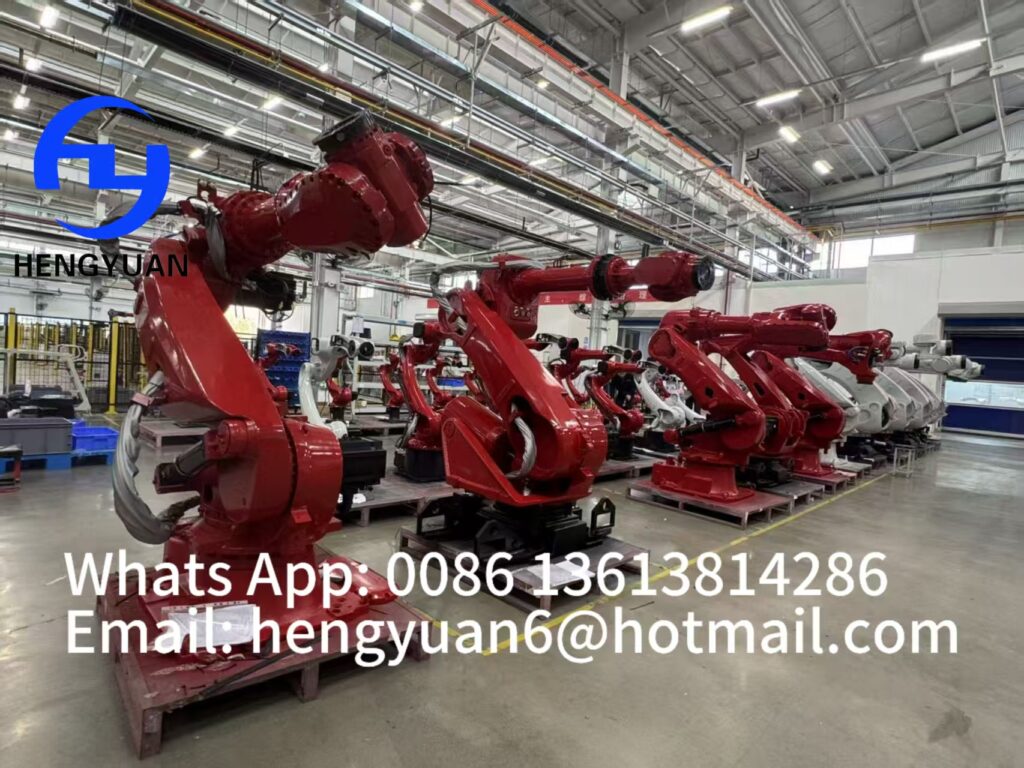
1. Heavy-duty 6-axis industrial robot
Designed for long, heavy profiles, with strong load capacity, high rigidity, and IP67 protection. Stable motion, precise positioning, and long reach enable reliable handling for 6m and 12m products.
2. Customized end-of-arm gripper
Built for profile steel with stable clamping, high-temperature resistance, and uniform force distribution. It avoids surface damage while ensuring fast pickup and placement.
3. Automatic conveying and lifting lines
Buffer chains, counting chains, sorting chains, and pickup stations work together to balance production flow, separate profiles, and maintain consistent rhythm.

4. Sorting, counting and alignment units
Automatically space profiles, count accurately, align ends, and form uniform layers—laying the foundation for neat palletizing.
5. Palletizing station and automatic strapping
Palletizing rollers, side alignment, and lifting mechanisms work with a high-speed strapping system. Stable strapping ensures neat, secure bundles ready for transport.
6. Intelligent electrical control system
Stable PLC control with touchscreen operation supports one-key product switching, fault self-diagnosis, production counting, and linkage with the main rolling line.
How the Automated Process Works
The entire system runs in continuous, coordinated flow:
- Profiles enter after straightening and fixed-length cutting
- Lifting and conveying systems transfer materials smoothly
- Buffer section balances line pressure and stabilizes beat
- Sorting and counting units group profiles automatically
- Alignment systems ensure tidy ends and uniform layers
- Robot picks and places layers precisely at the palletizing station
- After palletizing, bundles move to strapping automatically
- Strapping completes in a short cycle
- Finished bundles exit to the finished product area
- System resets and waits for the next cycle
Key Technical Strengths of Mature Systems
1. Strong adaptability
Covers angle steel, channel steel, flat bar and common profiles. Supports quick switching between multiple specifications through parameter recipes.
2. High stability
Modular mechanical design, redundant structure, and branded electrical components support long-term, low-failure operation.
3. High safety
Full safety fences, safety door interlocks, emergency stop loops, and anti-collision protection keep personnel away from high-risk areas.
4. High precision
Repeat positioning accuracy ensures neat layers and uniform bundles, improving storage and logistics efficiency.
5. High efficiency
Synchronized linkage with the rolling line eliminates unnecessary waiting and boosts overall line productivity.
6. Digital and intelligent
Real-time production monitoring, fault prompts, output statistics, and historical records support data-based management.
Real Value for Steel Producers

Beyond operational improvements, these systems bring long-term business value:
- Safety upgrade: Reduce high-risk manual operations and improve workplace conditions
- Stable quality: Uniform bundles improve appearance, inspection pass rate and customer satisfaction
- Efficiency improvement: 24-hour capable operation increases line utilization
- Cost optimization: Reduce reliance on heavy manual labor and lower long-term operating costs
- Management simplification: Standardized processes reduce fluctuation between shifts
- Market competitiveness: Intelligent equipment supports high-standard orders and export projects
For steel enterprises, this is not just a piece of equipment—it is a strategic upgrade to production reliability.
Who Benefits Most from This Upgrade?
- Section steel rolling mills (angle, channel, flat bar)
- High-standard bar & section combined production lines
- Mills focused on safety, quality stability, and brand image
- Enterprises with high labor costs or recruitment challenges
- New rolling lines planned with intelligent automation from the start
Closing Thought
The direction of modern steel manufacturing is clear: safer, more stable, more precise, and more intelligent.
Robotic palletizing systems represent a practical, proven step in that journey. They turn historically difficult, unstable processes into reliable, repeatable, and manageable workflows.
For mills looking to strengthen long-term competitiveness, this is not just about automation—it’s about building a more sustainable, reliable, and future-ready production system.