
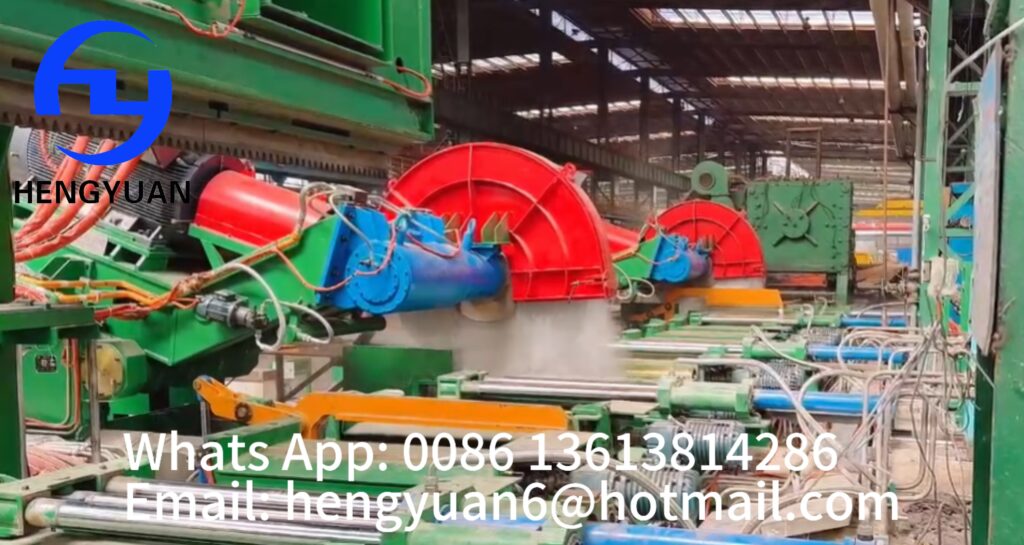
The cold sawing section, as a key process link in the rolling steel production line, undertakes the core task of fixed-length cutting of hot-rolled steel products. The stability and precision of its equipment directly affect the quality of finished steel products and the overall efficiency of the production line. Combined with the actual demand of the 650,000 tpy rolling steel project, this paper sorts out the complete set of equipment configuration, core technical parameters and process design points of the cold sawing section, providing a reference for equipment selection and production line construction in the rolling steel industry.
I. Adaptation of Cold Sawing Section Equipment to Production Capacity and Product Specifications
The cold sawing section equipment is designed to match the 650,000 tpy rolling steel project, enabling fixed-length cutting of various steel products such as deformed steel bars, round bars, angle steels, and channel steels. The production capacity and specification coverage of each category are as follows:
- High-speed bar: 250,000 tpy, Φ8~Φ25mm deformed steel bars, covering steel grades such as Q235, 45#, 20MnSi;
- General bar and round bar: 100,000 tpy, Φ28~Φ40mm deformed steel bars, Φ20~Φ110mm round bars, including steel grades such as 20MnSi, 45#~75#;
- Angle steel and channel steel: 100,000 tpy, 5#~10# angle steels, 5#~18# channel steels, suitable for Q235 steel grade, and can also be expanded to roll section steels such as square steel, flat steel, and I-beam.

All finished steel products comply with current national standards, with a fixed-length deviation controlled within +50mm, and a single bundle weight of 2000kg~3000kg for bundled delivery, meeting industrial-grade steel delivery specifications.
II. Complete Set of Core Equipment Configuration in Cold Sawing Section
The cold sawing section equipment adopts an integrated design, including main cutting equipment, conveying and positioning equipment, auxiliary supporting systems, etc., with a total weight of 133 tons. The complete set of equipment consists of 11 types of core units, with the specific configuration as follows:
- Sawing section roller table (45m): 1 set, responsible for steel conveying and material transfer for subsequent cutting;
- 1800 fixed saw: 1 set, core cutting equipment, suitable for fixed-length cutting requirements;
- 1800 moving saw: 1 set, core cutting equipment, which can flexibly adjust the cutting position to meet multi-specification fixed-length requirements;
- Side clamping devices: 5 sets, upper pressing devices: 2 sets, which jointly realize precise positioning of steel before sawing to prevent deviation;
- Thin oil lubrication system: 1 set, providing continuous lubrication for cutting equipment to ensure equipment operation;
- End-aligning baffle: 1 set, realizing alignment of steel ends to improve cutting consistency;
- Medium-pressure water system: 1 set, equipped with 1 set of valve station and pipeline, completing saw blade cooling and chip removal;
- Length gauge: 1 set, precisely controlling the cutting length of steel products, serving as the core positioning equipment;
- Electrical control equipment for sawing section: 1 set, realizing linkage control and operation of all regional equipment.
The complete set of equipment adopts an integrated design of mechanics, hydraulics, thin oil lubrication, and automatic control, with seamless connection between each unit. It can adapt to the continuous operation requirements of the rolling steel production line, supporting three control modes: manual, semi-automatic, and automatic. It also has functions such as inter-equipment safety interlock, fault alarm, and emergency shutdown to ensure production safety and efficiency.
III. Core Technical Parameters and Performance Characteristics of Key Equipment
(I) Sawing Section Roller Table (45m)
As the core conveying equipment, it is divided into 2 groups, consisting of roller assemblies, cover plates, and roller table frames. The core parameters are:
- Roller specifications: diameter φ240mm, length 1200mm, spacing 1100mm~1300mm, total about 36 pieces;
- Operating parameters: roller surface linear speed 1.0m/s, adopting 3kw variable frequency gear reducer, variable frequency speed regulation, adapting to different steel conveying rhythms;
- Transmission mode: single roller independent variable frequency drive, total about 36 motors, with strong conveying stability.
(II) Length Gauge
Arranged adjacent to the cold shear, it realizes precise control of steel cutting length. The structure includes a length gauge trolley, legs, crossbeam, hydraulic locking device, etc. The core parameters and characteristics are:
- Adaptable specifications: can meet fixed-length requirements of 80~110mm round bars, fixed-length 6m~12m, fixed-length accuracy 0~+25mm, with small cutting size error;
- Operating parameters: trolley moving speed 0.11m/s, driven by 1.5KW reduction motor, baffle lifting and trolley clamping driven by hydraulic cylinders, with precise actions;
- Structural characteristics: legs and crossbeam connected by flanges, convenient for installation and maintenance, drag chain design ensures smooth trolley movement, and can communicate with the production line in an interlocking manner.

(III) 1800 Fixed Saw / Moving Saw
As the core cutting equipment of the cold sawing section, the two have the same core sawing parameters. The moving saw adds a traverse function to adapt to flexible multi-fixed-length cutting. The following are the unified core parameters and exclusive features:
1. General Core Technical Parameters
- Sawing capacity: saw blade feed speed 10~300mm/s, maximum sawing capacity 1600mm²/s, return speed about 450mm/s, high cutting efficiency;
- Adaptable materials: alloy steels such as Q235B and 45#, capable of sawing Φ50~Φ150 round bars and medium-sized section steels, sawing temperature 100~300℃, adapting to the cutting requirements of hot-rolled steel products;
- Saw blade specifications: maximum diameter φ1800, minimum diameter φ1650, thickness 10-12mm, made of 65Mn high-quality spring steel, with rat tooth profile, strong cutting wear resistance;
- Power configuration: saw blade drive motor 450Kw, speed 1490rpm, thin oil lubrication system equipped with 1.1Kw oil inlet pump and 40L/min oil return pump, total installed capacity about 460KW;
- Control mode: manual/auto dual mode, interlocking communication with the production line, saw blade feed speed can be automatically adjusted with sawing resistance, and overload automatic alarm and speed reduction/return.
2. Exclusive Performance Characteristics
- Fixed saw: equipment outline size 5620x2370x3350, maximum saw blade working stroke 1500mm, compact layout, suitable for large-scale continuous cutting with fixed length;
- Moving saw: equipment outline size 5770x3470x4600, maximum saw blade working stroke 1700mm, equipped with 4Kw traverse motor, can move flexibly along the track, clamp rail clamping force 8000N, no offset during operation, adapting to multi-specification and variable fixed-length cutting requirements.
3. Common Structural Advantages
- Transmission system: motor + spiral bevel gear pair drive, equipped with well-known brand bearings, high transmission efficiency and reliable operation;
- Feed system: cylinder feed + linear guide sliding, stable sawing without jitter, swing hydraulic cylinder controls saw blade angle for faster cutting;
- Saw cover design: controlled by hydraulic cylinder to open and close, can swing about 60°, convenient for saw blade replacement and maintenance;
- Cooling and cleaning: high-pressure water nozzles installed in the saw cover, water curtain blocks saw chips, realizing synchronous cooling of saw blade and chip removal, reducing saw blade jamming and tooth breakage.
(IV) Auxiliary Supporting Systems
- Lubrication system: 2 sets of thin oil lubrication systems are set up for circulating lubrication of 2 cold saws, 3 sets of dry oil lubrication stations for automatic lubrication of cold saws and pre-saw roller tables, and other hinge points and sliding bearings adopt manual dry oil lubrication, comprehensively ensuring equipment operation;
- Medium-pressure water system: 1 working and 1 standby multi-stage centrifugal pump set, flow rate 30m³/h, rated pressure 2.7MPa, realizing saw blade cooling (preventing thermal expansion and fracture) and chip flushing, reducing equipment loss;
- Hydraulic valve stations: 3 sets of independent valve stations, respectively controlling 2 cold saws, sawing section pressing devices, lifting baffles and length gauges, with independent and controllable hydraulic actions without mutual interference;
- Electrical control system: adopts well-known brand PLC and flame-retardant cables, the power distribution cabinet is a Rittal-standard cabinet, and components such as frequency converters and soft starters are selected from high-quality industrial products. The HMI system can preset different steel process parameters, support real-time adjustment, and adapt to multi-category production.

IV. Core Process and Operation Characteristics of Cold Sawing Section Equipment
(I) Core Sawing Process Flow
- Pre-start preparation: start the lubrication pump and main motor in sequence, and place the pressing device and pusher mechanism in the standby position;
- Material positioning: after the steel is conveyed to the sawing position, the side clamping + upper pressing devices act to realize precise fixing of the steel, and the end-aligning baffle completes the alignment of the material end;
- Sawing operation: the swing hydraulic cylinder adjusts the saw blade to the working height, the feed hydraulic cylinder pushes the saw blade to feed at a speed of 10~300mm/s, and the speed is automatically adjusted according to the resistance during sawing;
- Reset preparation: after sawing is completed, the saw blade returns quickly (450mm/s), the swing hydraulic cylinder lifts the saw blade to the standby position, the pressing device is released, and a single cutting is completed, entering the next cycle.
(II) Overload Protection Mechanism
During sawing, if the motor current exceeds 1.25 times the rated current and lasts for 2 seconds, the equipment will automatically alarm and reduce the cutting speed by 20%; if the overload lasts for 5 seconds, the saw blade will immediately return at the maximum speed, effectively protecting core components such as the saw blade and motor and reducing equipment damage.
(III) Equipment Operation and Maintenance Characteristics
- Saw blade replacement: the saw blade is clamped by a hydraulic locking device, which can be quickly disassembled and installed after loosening without complex tools;
- Local operation: local boxes are set at the front and rear limit points of the equipment, enabling close-range operation for convenient equipment maintenance and roller table maintenance;
- Wear parts management: the equipment design fully considers the replacement needs of wearing parts, with reasonable layout of key parts, short maintenance time, and reduced production line downtime.
V. Equipment Manufacturing, Acceptance and Service Standards
(I) Manufacturing and Supporting Parts Standards
- Equipment manufacturing strictly follows current national and metallurgical industry standards, covering the whole process of welding, tolerance, gear processing, surface treatment, etc., to ensure equipment processing accuracy;
- Key supporting parts are selected from high-quality industrial products, and high-quality brands are designated for roller table reducers/motors, hydraulic cylinders, chains, bearings, etc., with controllable quality of core components.

(II) Inspection and Acceptance Requirements
- Factory inspection: partial assembly is completed before equipment delivery, with no jamming or abnormal noise in rotating parts, and unqualified equipment is strictly prohibited from leaving the factory;
- On-site test run: divided into no-load test run (single/linkage simulation test run) and hot load test run, with normal continuous operation test run not less than 6 hours, and all indicators must comply with the code for construction and acceptance of metallurgical equipment installation engineering;
- Quality guarantee commitment: during the equipment warranty period, if non-wearing parts are damaged under normal use, the supplier will repair or replace them free of charge.
(III) Installation and Technical Services
- The supplier is responsible for the installation and commissioning of the complete set of equipment, assists the demander in completing the hot load test run, and provides on-site technical services;
- Provide professional training for the demander’s operators to ensure standardized equipment operation and maintenance;
- Provide complete set of technical documents and drawings as required, including general drawings, component drawings, wearing parts drawings, operation manuals, maintenance manuals, etc., and provide as-built drawings and spare parts lists to ensure later equipment operation and maintenance.
VI. Application Value of Equipment
This complete set of cold sawing section equipment is tailor-made for the 650,000 tpy rolling steel project, with three core advantages of high adaptability, high precision, and high stability. It can realize continuous fixed-length cutting of multi-category and multi-specification steel products, with high sawing precision and flat, burr-free cuts, effectively reducing steel loss; the equipment adopts integrated linkage control, with convenient operation and low maintenance cost, and can be seamlessly integrated into the rolling steel production line, helping to improve the overall efficiency of the production line, ensure the quality of finished steel products, and adapt to the large-scale and standardized production needs of the metallurgical industry.