
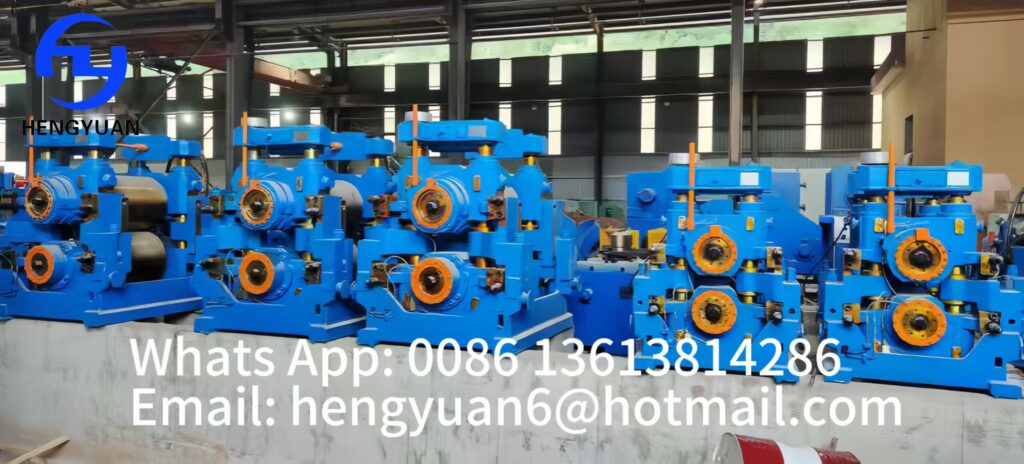
As the core equipment of modern steel rolling production, high-stiffness short stress line rolling mills target the industry-wide pain points of traditional rolling mills in actual production—low precision, poor stability, high failure rate, slow roll change, high operation and maintenance costs, low production capacity, inconsistent product quality and weak working condition adaptability. Through structural innovation, process optimization and functional upgrading, they achieve an all-round solution to these problems, fundamentally improving the operation efficiency, product precision and comprehensive benefits of steel rolling production lines. Adaptable to various rolling scenarios such as high-speed wire rod, high-speed bar and section steel rolling, they are the core solution for steel mills to upgrade production lines, reduce costs and increase efficiency.
Core Product Advantages: Targeted Pain Point Solutions
1. Solve the problems of severe vibration, large deformation and low rolling precision of traditional rolling mills
Adopting a short stress line design and a low center of gravity structural layout, the rolling mill features greatly enhanced stiffness, minimal springback, small overturning moment, and significantly reduced deformation and vibration during operation. Equipped with high-stiffness lateral positioning and axial spherical limit devices, it suppresses displacement and movement in multiple dimensions, completely solving the problems of large dimensional deviation and poor surface quality of rolled products caused by vibration in traditional rolling mills. The dimensional tolerance control precision of rolled products is improved by more than 30%, and the finished product precision reaches IT6-IT7 grade.
2. Solve the problems of unstable roll system balance, large impact load and frequent equipment failures
Mainstream models are configured with elastic damping/laminated spring elastic balance, and large-size models are supplemented with hydraulic balance. The dual balance design achieves dynamic stability of the roll system and effectively absorbs rolling impact loads. Built-in spring balance damping body further buffers high-frequency vibration, greatly reducing bearing seat failures, roll system jams and other problems caused by unbalanced balance and damping damage. The equipment failure rate is reduced by more than 60%, and the continuous operation rate of the production line is increased by more than 15%.
3. Solve the problems of slow roll gap adjustment, poor precision and cumbersome operation
Innovatively equipped with hydraulic motor + manual symmetric dual-mode radial adjustment: hydraulic adjustment features fast response and is suitable for batch production, while manual adjustment has fine precision and is convenient for emergency fine-tuning. The precision of the screw down turbine pair reaches grade 7, with a roll gap adjustment error within ±0.01mm. The axial direction adopts a built-in worm gear with double bolt locking, and the control end is designed externally, making on-site adjustment safe and convenient. It completely solves the problems of time-consuming adjustment, difficult precision control and high labor intensity of operators in traditional rolling mills.

4. Solve the problems of poor sealing, easy corrosion and short service life of core components
The mechanical pull rod and bearing seat adopt a triple protection structure of coated multi-layer sealing + labyrinth auxiliary sealing, which is waterproof, dustproof and resistant to iron oxide scale intrusion. It completely solves the problems of bearing water inflow, dust jamming and component corrosion caused by seal failure in traditional rolling mills, prolongs the service life of core components by 2-3 times, and reduces the frequency of spare parts replacement and downtime for maintenance.
5. Solve the problem of single lubrication method and mismatching with working conditions
According to rolling speed, load intensity and production environment, dry oil lubrication, oil-gas lubrication or combined lubrication mode can be flexibly selected: dry oil is suitable for low-speed and heavy-load working conditions, and oil-gas is suitable for high-speed continuous production. It realizes precise matching of lubrication mode with actual working conditions, solves the problems of fast component wear caused by insufficient lubrication or resource waste and on-site pollution caused by excessive lubrication in traditional rolling mills, and ensures the long-term smooth operation of key moving components.
6. Solve the problems of slow roll change, complicated maintenance and long non-production downtime
Adopting modular integrated design and quick disassembly structure, the rolling mill has a compact overall structure and a reasonable layout of core components. With the cooperation of special hoisting auxiliary devices, the roll change time is shortened to 1/3 of that of traditional rolling mills, and the stand change efficiency is increased by 50%. The separate design of rolling mill body and mill train frame results in clear component division, and disassembly, assembly and maintenance do not require large-scale equipment, completely solving the problems of time-consuming maintenance and production impact of traditional rolling mills.
7. Solve the problems of inconsistent product quality, poor uniformity and low added value
Through multi-dimensional precise control of radial, axial and lateral directions, combined with high-stability operation characteristics, the dimensional error of rolled products is minimized and the surface finish is improved (Ra0.8~1.6μm). It completely solves the problems of unstable product size and many surface scratches in batch production of traditional rolling mills, greatly improves the consistency of product quality, reduces the follow-up processing allowance, effectively increases product added value, and meets the rolling requirements of high-end steel products.
8. Solve the problems of weak equipment adaptability, low production capacity and high energy consumption
Covering PD/PK/DN three major series, with roll diameter of φ320~φ720mm and rolling pressure of 1500~4000KN, the rolling mills can be deeply customized according to steel mill production scale, steel grade characteristics (carbon steel/alloy steel/special steel) and process requirements (1-5 slitting rolling), and are adaptable to various rolling scenarios such as high-speed wire rod, high-speed bar and section steel rolling. The stable operation and controllable precision of the equipment reduce the scrap rate of rolled products, the operation rate of the production line is increased by 15-20%, the output per unit time is increased by more than 20%, and the energy consumption is 10-15% lower than that of traditional rolling mills. It completely solves the problems of “one machine being difficult to adapt to multiple working conditions, insufficient production capacity release and high energy consumption” of traditional rolling mills.
Complete Product Series & Key Technical Parameters
The short stress line rolling mills cover three major series: PD, PK and DN. Each series covers the full roll diameter range from φ320mm to φ720mm, can meet different rolling pressure requirements of 1500KN~4000KN, and is suitable for various production scenarios from small and medium-sized wire rod mills to large steel enterprises. The key technical parameters of the main models of each series are as follows (for reference only, can be customized and adjusted according to actual needs):

PD Series
- PD350: Roll diameter φ320~φ390mm, roll body length ~650mm, max rolling pressure 1500KN, max rolling torque 100KN.m, axial adjustment ±3mm, suitable for rolling of small and medium-sized wire rod and bar
- PD450: Roll diameter φ400~φ480mm, roll body length ~650mm, max rolling pressure 2000KN, max rolling torque 150KN.m, axial adjustment ±4mm, suitable for rolling of medium and large bar and section steel
- PD550: Roll diameter φ510~φ610mm, roll body length ~760mm, max rolling pressure 2800KN, max rolling torque 200KN.m, axial adjustment ±5mm, suitable for heavy-load bar and alloy steel rolling
- PD650: Roll diameter φ570~φ720mm, roll body length ~800mm, max rolling pressure 4000KN, max rolling torque 350KN.m, axial adjustment ±4mm, suitable for large high-speed bar and composite line rolling
PK Series
- PK350: Roll diameter φ320~φ380mm, roll body length ~650mm, max rolling pressure 1500KN, max rolling torque 100KN.m, axial adjustment ±3mm, suitable for precision wire rod and small bar rolling
- PK450: Roll diameter φ420~φ480mm, roll body length ~650mm, max rolling pressure 2000KN, max rolling torque 150KN.m, axial adjustment ±4mm, suitable for mid-to-high end bar and section steel rolling
- PK550: Roll diameter φ520~φ610mm, roll body length ~600mm, max rolling pressure 2800KN, max rolling torque 200KN.m, axial adjustment ±4mm, suitable for high-strength alloy steel and large bar rolling
- PK650: Roll diameter φ610~φ720mm, roll body length ~800mm, max rolling pressure 3500KN, max rolling torque 350KN.m, axial adjustment ±4mm, suitable for heavy-load high-speed bar and special steel rolling
DN Series
- DN350: Roll diameter φ330~φ380mm, roll body length ~650mm, max rolling pressure 1500KN, max rolling torque 100KN.m, axial adjustment ±3mm, suitable for general wire rod and bar rolling
- DN450: Roll diameter φ400~φ480mm, roll body length ~700mm, max rolling pressure 2000KN, max rolling torque 150KN.m, axial adjustment ±3mm, suitable for multi-functional bar and section steel rolling
- DN550: Roll diameter φ520~φ610mm, roll body length ~760mm, max rolling pressure 2800KN, max rolling torque 200KN.m, axial adjustment ±3mm, suitable for heavy-load alloy steel and composite line rolling
- DN650: Roll diameter φ610~φ700mm, roll body length ~800mm, max rolling pressure 4000KN, max rolling torque 350KN.m, axial adjustment ±3mm, suitable for extra-large high-speed bar and special section steel rolling
All models adopt a separate design of rolling mill body and mill train frame. The mill train frame is standard equipped with static rail seat, spindle bracket, removal device and auxiliary accessories such as oil cylinders and locking cylinders, with clear component division for convenient disassembly, assembly and replacement. Key structural parts are forged from high-strength alloy steel, and internal stress is eliminated through heat treatment, featuring high strength, strong anti-deformation capacity and long-term resistance to high-intensity rolling loads.
Core Performance Highlights

- High load capacity & durability, wide working condition adaptability
- Superior rolling precision, upgraded product quality
- High customization level, excellent production line matching
- Economical operation and maintenance cost, remarkable comprehensive benefits
- Comprehensive safety design, safe operation
Applicable Scenarios
High-stiffness short stress line rolling mills accurately solve the core pain points of various steel rolling production lines and are adaptable to the full-scenario rolling needs of the metallurgical industry, including but not limited to:
- High-speed wire rod rolling production lines (φ6-φ16mm wire rod)
- High-speed bar rolling production lines (φ12-φ40mm bar)
- Conventional bar and wire rod rolling production lines (various specifications of ordinary carbon steel and low-alloy steel bar and wire rod)
- Section steel rolling production lines (angle steel, square steel, flat steel, channel steel, etc.)
- High-speed bar and wire rod composite rolling production lines
- Special steel rolling production lines (alloy steel, stainless steel, high-strength steel, etc.)
It is an ideal core equipment for steel mills to solve the pain points of traditional production lines, upgrade production equipment, improve product quality, increase production efficiency and reduce operating costs. It can help enterprises build differentiated advantages in the fierce market competition and achieve sustainable development.