
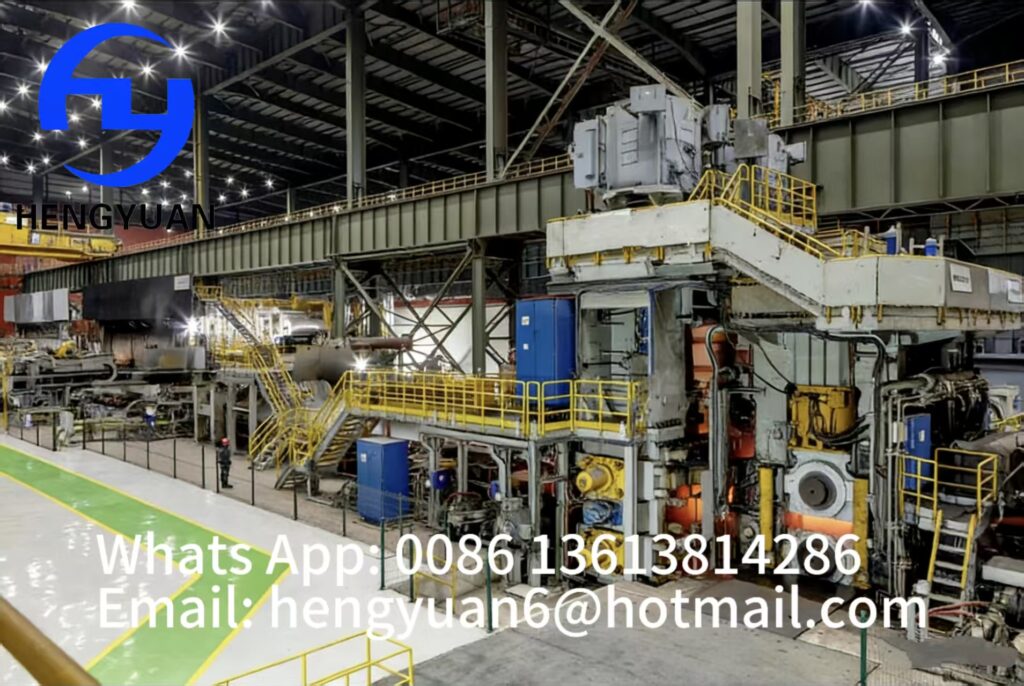
In the roar of steel mill rolling mills, the saying “A 1°C difference in temperature leads to a 1-grade drop in performance” is no exaggeration. Rolling temperature is the invisible hand that determines the final properties of alloys, turning ordinary steel billets into high-strength ship plates or premium aerospace alloys, while improper temperature control can turn precision aluminum alloy sheets into scrap. This article breaks down how rolling temperature regulates alloy microstructure (grain size, phase composition, texture, defects) and mechanical properties (strength, ductility, fatigue life, corrosion resistance), and shares practical optimization strategies for steel rolling production lines.
I. The Core Role of Rolling Temperature: A Dual Game of Thermodynamics and Kinetics
Rolling is the process of plastically deforming metal stock under roll pressure, either at room temperature or elevated temperatures. Rolling temperature (T, the initial temperature of the billet entering the rolls) and deformation temperature (Td, the real-time temperature during rolling) together form the thermal-mechanical environment for alloy deformation. Temperature changes trigger three core effects that determine the alloy’s final performance:
- Thermodynamic effect: Drives phase transformation and recrystallization
- Kinetic effect: Controls atomic diffusion rate
- Mechanical effect: Adjusts deformation resistance
1. Rolling Temperature Zones and Their Physical Significance
Based on material thermodynamic properties, rolling temperature is divided into four key zones, each with a dominant microstructure evolution mechanism:

Note: Tm(steel) ≈ 1800K, Tm(Al) ≈ 933K
2. Dual Pathways of Temperature Impact on Microstructure
Rolling temperature regulates alloy microstructure through two dimensions:
- Thermodynamic Path (Phase Transformation Driver): Controls recrystallization, phase transformation, and diffusion activation energy, directly determining whether the alloy undergoes work hardening elimination, phase transformation, or precipitation.
- Kinetic Path (Deformation Resistance Regulator): Follows the Arrhenius equation, where deformation resistance decreases exponentially with increasing temperature. For example, low-carbon steel’s deformation resistance drops from ~200MPa at room temperature to ~50MPa at 800°C, a 75% reduction, directly impacting rolling energy consumption and equipment selection.
II. Key Mechanisms: How Temperature Shapes Microstructure and Properties
1. Cold Rolling Zone (<0.4Tm): “Pure Mechanical Deformation” at Low Temperatures
Cold rolling is performed at room temperature or low temperatures, with almost no atomic diffusion, and microstructure evolution centered on dislocation motion:
- Microstructure Characteristics: Elongated fibrous grains, sharply increased dislocation density (from 10¹⁰m⁻² to 10¹⁵m⁻² at 80% reduction), high-density dislocation tangles, and unchanged coarse second-phase particles.
- Property Impact: Significantly increased strength (e.g., cold-rolled 304 stainless steel yield strength rises from 205MPa to 1200MPa), sharply reduced ductility (elongation drops from 50% to 5%), and high residual stress.
- Industrial Application: Cold-rolled silicon steel sheets (0.35mm thick) require 5-7 rolling passes, with intermediate annealing (750°C×1h) to eliminate stress and avoid magnetic property degradation.

2. Hot Rolling Zone (0.6Tm-0.8Tm): “Microstructure Reconstruction” Dominated by Recrystallization
Hot rolling is the most common rolling process, with active atomic diffusion and Dynamic Recrystallization (DRX) as the core of microstructure evolution:
- DRX Evolution: Nucleation (deformation storage energy accumulation) → Nucleus growth (grain refinement) → Completion (full recrystallization)
- Temperature Regulation Law: Nucleation rate increases exponentially with temperature, while high temperatures increase the risk of grain coarsening.
- Property Impact: Refined grains (Hall-Petch effect) achieve simultaneous improvement of strength and toughness. For example, when a steel mill hot-rolled Q345, increasing the finishing temperature from 850°C to 950°C refined DRX grains from 15μm to 8μm, raising yield strength from 345MPa to 420MPa while maintaining elongation above 25%.
3. Warm Rolling Zone (0.4Tm-0.6Tm): “Semi-Hot Deformation” Assisted by Thermal Activation
Warm rolling sits between cold and hot rolling, with limited atomic diffusion and Dynamic Recovery (DRV) as the dominant mechanism:
- Microstructure Characteristics: Equiaxed or elongated subgrains, dislocation density 10¹²-10¹³m⁻² (lower than cold rolling)
- Property Impact: Medium strength, better ductility than cold rolling (elongation 15%-25%), ideal for low-ductility alloys. For example, warm rolling Ti-6Al-4V titanium alloy at 400°C increased elongation from 8% to 18%, solving the problem of thin-walled part forming cracking.
III. Temperature Effects on Different Alloy Systems: Practical Cases for Steel Rolling Production
1. Steel Materials: The Classic Example of Temperature-Microstructure-Property Relationship
- Low Carbon Steel: Finishing Rolling Temperature (FRT) in the Ar₃-Ar₁ ferrite precipitation zone ensures full DRX and grain refinement; FRT below Ar₃ leaves unrecrystallized austenite and coarse grains. Coiling Temperature (CT) of 550-650°C precipitates fine cementite for high strength, while CT above 700°C causes cementite coarsening and strength reduction.
- Stainless Steel: Cold-rolled 304 requires solution treatment (1050°C water quenching) to eliminate work hardening and dissolve Cr₂₃C₆ carbides, restoring corrosion resistance. Skipping solution treatment leads to pitting corrosion in Cl⁻ environments.

2. Aluminum Alloys: The Art of Strength-Ductility Matching
- Wrought Aluminum Alloys (e.g., 6061): Hot rolling (450-500°C) refines grains to 10μm (strength 280MPa, elongation 25%); warm rolling (200-300°C) achieves subgrain strengthening (strength 320MPa, elongation 15%); cold rolling achieves work hardening (strength 400MPa, elongation 8%).
- Industrial Application: New energy vehicle battery housing 3003 aluminum alloy uses a “hot rolling + warm rolling” combined process to ensure both strength (180MPa) and deep stamping formability (elongation >30%).
3. Magnesium Alloys: Breaking Through Texture Weakness with Temperature
Magnesium alloys (HCP structure) have poor room-temperature ductility and strong texture, making warm rolling a key technology:
- Cold rolling (25°C): Dominated by basal slip, strong {0001}<10-10> texture, elongation <5%
- Warm rolling (200-300°C): Activates non-basal slip, reduces texture strength, increases elongation to 15%-20%
- Hot rolling (350-400°C): DRX forms equiaxed grains, randomizes texture, elongation >25%
IV. Industrial Application: Rolling Temperature Optimization Strategies for Steel Rolling Lines
1. “Golden Rules” for Rolling Temperature Selection
- Target Performance Orientation: High strength → Hot rolling + low-temperature coiling; Ductility → Hot rolling + high-temperature coiling; Isotropy → Warm rolling + cross rolling
- Alloy Property Adaptation: Low-ductility alloys (Mg, Ti) → Warm/hot rolling; High-ductility alloys (Al, Cu) → Cold/hot rolling
- Process Constraint Consideration: Equipment capacity, surface quality, energy cost (hot rolling energy consumption is 3x that of cold rolling)
2. Typical Case: Gradient Temperature Control for Aerospace Aluminum Alloy Thick Plates
An aircraft manufacturer produced 7050 aluminum alloy thick plates (100mm thick) requiring yield strength ≥500MPa and -196°C impact energy ≥27J:
- Traditional Process: Single-pass hot rolling at 450°C, final thickness 100mm, grain size 25μm, strength 480MPa, impact energy 22J (failed to meet standards)
- Optimized Process: Multi-pass gradient temperature-controlled rolling Rough rolling: 480°C, 50% reduction, DRX grain size 15μm Finish rolling: 420°C, 30% reduction, subgrain strengthening Water quenching after finish rolling (to prevent overaging)
- Result: Grain size 12μm, strength 520MPa, impact energy 30J, fully meeting requirements

3. Future Trend: Intelligent Temperature Control and Digital Twin
- AI Real-Time Temperature Optimization: Adjust rolling temperature dynamically via infrared thermography + machine learning models, improving yield by 2%
- Ultra-Fast Heating Technology: Electromagnetic induction heating (100°C/s heating rate) for local precise temperature control
- Digital Twin Platform: Build “temperature-microstructure-property” virtual models to simulate phase transformation under different temperatures
V. Conclusion
Rolling temperature regulates alloy microstructure and final mechanical, physical, and chemical properties through the synergy of thermodynamic, kinetic, and mechanical effects. Cold rolling focuses on work hardening for high-precision thin sheets; warm rolling improves the ductility of low-ductility alloys via dynamic recovery; hot rolling achieves grain refinement through dynamic recrystallization for excellent comprehensive performance; ultra-high temperature rolling requires vigilance against grain coarsening and overburning risks.
As a professional supplier of steel rolling production line equipment, we understand that precise rolling temperature control is the core of high-quality steel production. Our rolling mill equipment supports precise temperature regulation, helping steel mills achieve stable control of “temperature-microstructure-property” and produce high-performance steel products that meet aerospace, new energy vehicle, and pipeline steel standards.
If you are looking to upgrade your steel rolling production line or optimize rolling temperature control processes, feel free to connect with us for customized technical solutions!