
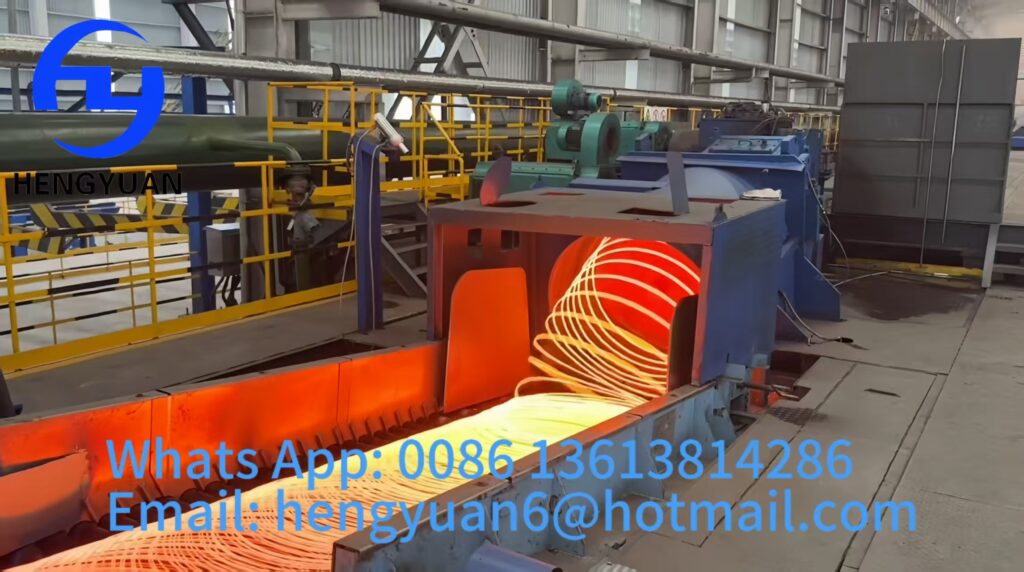
1. Process Challenges Overview
For large‑size special steel wire rods above Φ21 mm, the ideal production route is a high‑speed bar mill with a coiler. When using the traditional high‑speed wire rod mill + laying head process, production difficulty increases sharply.
Typical pain points:
- Frequent cemented carbide roll ring fractures
- Severe and recurring surface scratches
- Uncontrollable tail loop shape
- Poor coil appearance after collection
High‑alloy grades such as bearing steel, spring steel, and alloy structural steel often require low‑temperature rolling and dual‑phase region rolling, making rolling conditions even tougher.
2. Roll Ring Fracture
Roll ring fracture is the most common failure, especially for the Φ150 mm cemented carbide roll ring in the sizing mill.
Key Causes
- Excessive head temperature drop during long‑distance transfer, creating “black‑end steel”
- Insufficient locking between roll ring, taper sleeve, and shaft
- Pass fill rate exceeding 95% causing extreme stress concentration
- Higher rolling force and lower roll strength due to large cross‑section
- High deformation resistance from high‑alloy components
Solutions
- Strictly control the head temperature to avoid excessive cooling
- Apply waterproof protection for cooling equipment downstream of the shear
- Optimize water cooling and temperature recovery time
- Ensure reliable locking with contact area ≥ 80%
- Control RSM pass fill rate within 90%–95%
- Avoid insufficient filling that causes ridges or unprocessed surfaces

3. Surface Scratching
Large self‑weight and high bending resistance lead to strong friction, making surface scratching highly prominent.
Key Causes
- High friction in the downward bending guide of the laying head
- Improper laying pipe inner diameter and internal wear grooves
- Misalignment of laying head, pinch roll, and guides
- Unpolished rollers on the cooling conveyor
- Small‑to‑large size changeover causing scratches from worn grooves
Solutions
- Use guide‑wheel type downward bending devices with reliable cooling and lubrication
- Optimize laying pipe inner diameter based on size ranges
- Arrange production sequence from large to small
- Maintain high‑precision alignment of all guiding components
- Regularly inspect wear and polish rollers and guides
- Optimize forming guide length and use 1–3 movable plates
4. Tail Loop Control
Poor tail loop shape appears as small loops, loose loops, fan‑shaped distribution, or messy coils.
Key Causes
- Insufficient inertia when the tail leaves the laying head
- Speed mismatch and response lag between rolled piece, pinch roll, and laying head
- Excessive drop height during coil collection
- Unreasonable laying head oscillation parameters
- Loose loops fixed after cooling on the conveyor
Solutions
- Adopt tail speed‑up control for laying head and pinch roll
- Synchronize speed regulation of RSM, laying head, and pinch roll
- Optimize acceleration ramp for better matching
- Adjust oscillation parameters to avoid overly small loops
- Use “tail pause” mode on the cooling conveyor
- Adopt high‑position collection to reduce drop height and tilting

5. Benefits Achieved by Process Optimization
After full‑process optimization, the production line achieves significant improvements:
✅ Smoother Production
Greatly reduced roll ring fracture and downtime
✅ Higher Quality
Virtually eliminated surface scratches and improved dimensional accuracy
✅ Lower Cost
Reduced roll consumption, higher yield, lower overall manufacturing cost
✅ Greater Efficiency
Smoother coordination between rolling, laying, cooling, and collection
✅ Stronger Competitiveness
Stable mass production of high‑value large‑size special steel wire rods
6. Future Outlook
With the upgrading of high‑end manufacturing, the market for large‑size special steel wire rods will continue to grow.
Future trends:
- Intelligent Rolling: Digital twin, online temperature monitoring, adaptive control
- High‑Efficiency & Green Production: Low‑temperature rolling, energy‑saving cooling
- Customized Manufacturing: Flexible production for automotive, machinery, and energy
- Full‑Chain Quality Traceability: Online inspection and closed‑loop quality control
Continuous process innovation and intelligent upgrading are the keys to high‑quality, high‑efficiency, and low‑cost production.

7. Summary
The core challenges come from low rolling speed, continuous temperature drop, high deformation resistance, large self‑weight, and high friction.
Only through full‑process targeted optimization – including temperature control, roll pass design, equipment locking, guide upgrading, laying head tuning, and speed curve matching – can stable production and consistent quality be achieved.
Systematic process improvement completely solves pain points and strongly supports the high‑end localization of special steel wire rods.