
Since the 2018 implementation of the new national standard for hot-rolled ribbed steel bars, traditional processes have struggled with limited capacity, high costs, and unstable performance. The innovative controlled rolling & cooling technology for bar steel—built on process innovation and equipment upgrades—has broken key industry bottlenecks, emerging as a technical benchmark.
Ⅰ✨ Core Technical Highlights & Advantages
1. Innovative Process System for Precise Temperature Control & Efficiency Enhancement
1.1 Establish a full-process controlled rolling and cooling system of “rolling + cooling + rolling + cooling + rolling + weak cooling”, adopting a multi-stage controlled cooling process of “cooling + recovery + cooling” (with extended recovery sections in some schemes) to achieve precise temperature regulation.

1.2 Optimize process layout by adding a finishing mill group and the 2nd stage of controlled cooling. The rolled pieces are cooled to 750-830℃ through the 2nd stage of controlled cooling, then undergo recovery before finishing rolling, followed by weak cooling after final rolling to form a three-stage cooling mode, perfectly adapting to the requirements of low-temperature rolling.
1.3 Reconstruct the pass system by moving the splitting pass forward. After splitting, the rolled pieces are rolled into round pieces through multiple passes to avoid the formation of sharp-angle hard phases and reduce the risk of rolling defects from the source.
2. Equipment Upgrading for Stable Production Support
2.1 Expand the capacity of finishing mill motors and replace traditional DC motors with AC motors, reducing daily maintenance workload and significantly improving equipment operational stability.
2.2 Adopt high-speed steel rolls combined with high-precision CNC machining equipment to completely solve the industry pain point of severe roll wear under low-temperature rolling.

2.3 Intelligent control upgrade: Install quick-opening solenoid valves in the 2nd stage of controlled cooling, which precisely control the on/off of water valves through photoelectric sensing, allowing the head of rolled pieces to avoid cooling water. The temperature of the head entering the finishing mill is stably maintained above 980℃, reducing equipment impact damage.
3. Synergy of Composition & Process to Break Alloy Dependence
3.1 Innovatively adopt “grain refinement strengthening + dislocation strengthening” to replace traditional alloy solid solution strengthening and precipitation strengthening, reducing reliance on high-priced silicon (Si)-rich and manganese (Mn)-rich alloys.
3.2 Optimize chemical composition ratio: reduce Si content to below 0.45% and Mn content to below 1.40%, replacing them with a small amount of niobium (Nb) alloy to maximize raw material cost control while ensuring product performance.

Ⅱ🔧 Key Industry Pain Points Addressed
1.Capacity Constraints: The original process required reducing rolling speed to maintain the controlled cooling temperature (around 950℃). The new process achieves precise temperature control at normal rolling speeds, with the finished product line speed reaching 14m/s for Φ25mm bars and 14m/s for Φ18mm×2 bars, completely releasing production line capacity.
2. Unstable Performance: Solve the problem of strong performance aging tendency of original products after warehousing, with some products failing to meet the national standard for yield strength. The new process ensures long-term stable product performance and 100% qualified macrostructure.
3. High Cost Pressure: Break away from dependence on high-priced Si-rich and Mn-rich alloys, directly reducing the alloy cost per ton of steel by 5 USD. Combined with reduced equipment maintenance costs, it achieves significant comprehensive cost advantages.
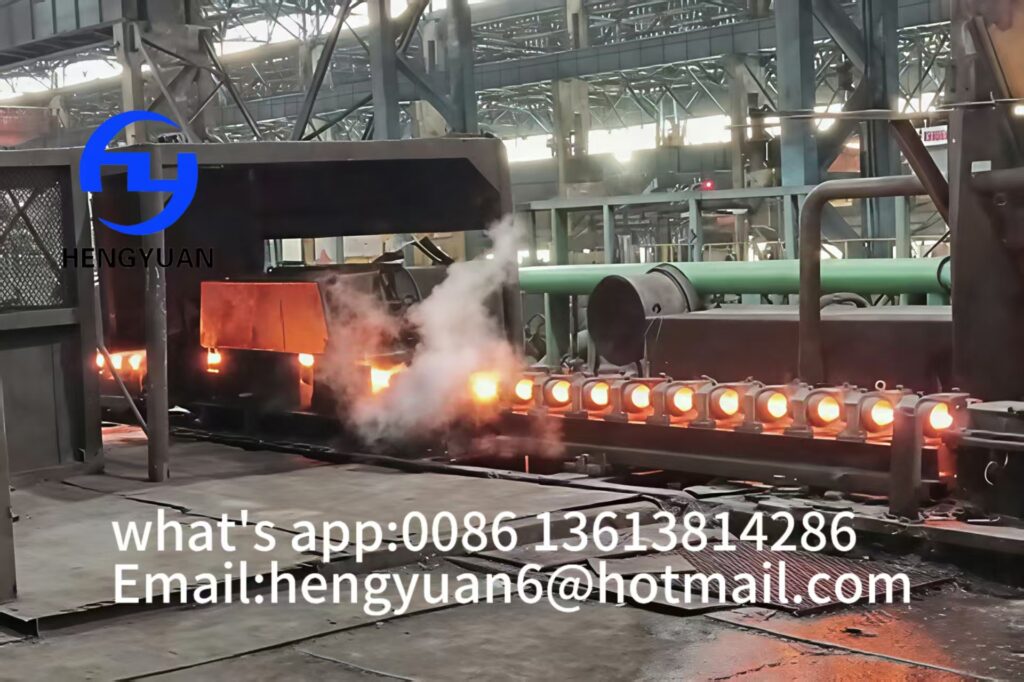
4. Severe Equipment Wear: Through the application of high-speed steel rolls and head temperature control optimization, solve the pain points of rapid roll wear, frequent pass replacement, and high pass chipping rate under low-temperature rolling. The pass chipping rate decreases from 30% to 5%, extending equipment service life.
5. Process Adaptation Difficulties: Achieve dynamic balance among “speed, quality, and cost”, breaking the inherent contradiction in traditional processes that “improving performance requires adding alloys and ensuring quality requires reducing speed”.
Ⅲ💡 Core Benefits Brought
1. Production Benefits: Dual Improvement in Capacity & Quality
The actual hourly output is stably maintained at 166.8-194.0t/h, with fully released capacity. Product indicators fully meet the new national standard: yield strength of 450-495MPa, tensile strength of 586-620MPa, elongation of 19.98%-31.27%. The macrostructure is high-quality ferrite + pearlite (pearlite content of 35-40%) with a grain size of 10.5-11 grades.
Significantly reduce equipment failure rate, enhance production continuity, and minimize efficiency losses caused by shutdowns for roll replacement and steel piling.

2. Economic Benefits: Substantial Cost Optimization
Reduce the alloy cost per ton of steel by 5 USD. Combined with reduced roll wear and motor maintenance costs, it achieves significant profit growth in long-term production. The technical transformation does not require additional large-scale investment, featuring a high input-output ratio and suitability for wide industry promotion.
3. Technical Value: Setting an Industry Benchmark
Form a replicable technical paradigm of “low-temperature finishing rolling + multi-stage controlled cooling + composition optimization”, providing a mature solution for the upgrading of similar bar steel production lines and promoting the transformation of bar steel production in the iron and steel industry towards green, low-carbon, efficient, and low-cost development.
With innovation-driven breakthroughs in industry bottlenecks, this technology not only guarantees product quality and capacity scale but also achieves precise cost control, providing strong support for the technological upgrading and high-quality development of bar steel production in the iron and steel industry!