
Elevate Safety, Efficiency, and Traceability in Bar Stock Manufacturing
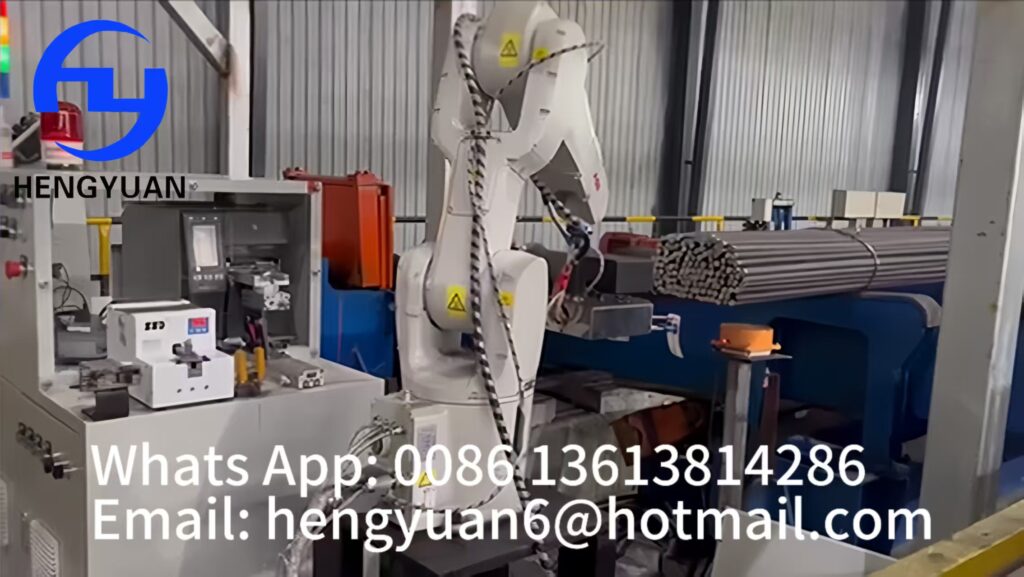
In steel bar production facilities, the final labeling process for bundled bars has long relied on manual labor—exposing workers to high surface temperatures, heavy lifting, and risks of burns or impact injuries. Manual operations are not only labor-intensive but also prone to human error, leading to inconsistent label placement, printing mistakes, and subsequent challenges in quality traceability. Furthermore, manual labeling speeds struggle to keep pace with high-speed production lines, often causing bottlenecks that limit overall throughput. Data recorded manually is also susceptible to omissions or inaccuracies, breaking the product traceability chain. In the event of quality issues, root-cause analysis becomes cumbersome, potentially resulting in large-scale recalls or customer complaints. Today, automated welding label robot systems—integrating core subsystems like 3D visual inspection, robotic execution, intelligent control, and data communication modules—are redefining this critical workflow. By fusing precision engineering with smart technology, these integrated systems address traditional pain points while comprehensively enhancing operational performance, emerging as a cornerstone for digital transformation in steel manufacturing.
Why Automated Welding Label Robots Are a Game-Changer
For manufacturers handling steel bar bundles, the shift to automation resolves three core challenges, acting as a key driver for production model upgrading:
- Safety as a Priority: Automated robots fully replace manual labor in high-temperature labeling tasks, eliminating direct human contact with hot bundles and heavy labeling equipment. This fundamentally mitigates risks of burns, crush injuries, and other workplace accidents. Complemented by physical safety guardrails, emergency stop systems, and conveyor interlock mechanisms, the robots trigger immediate shutdowns if personnel enter restricted zones or equipment malfunctions—erecting a dual layer of protection for workshop safety.
- Enhanced Traceability for Quality Control: The system automatically receives critical production data (e.g., weight, batch number, heat number, rolling number) from on-site measurement and metering systems, enabling precise label printing (supporting numbers, letters, barcodes, and QR codes) via dual redundant printers and targeted welding. Data is synced in real time with enterprise ERP platforms through industrial Ethernet communication modules, creating a complete end-to-end product traceability chain. Full-lifecycle information for each bundle is readily retrievable and permanently stored (with a 6-month data archiving function), meeting stringent traceability requirements for steel used in construction, automotive, and other industries. In case of quality issues, manufacturers can quickly pinpoint production stages and responsible parties, minimizing quality-related losses.
- Automation Upgrade to Unlock Production Potential: Robots operate 24/7 with consistent performance, unaffected by fatigue, skill gaps, or shift schedules. This reduces reliance on manual labor, cutting recruitment and management costs while maintaining uniform quality and efficiency. The integrated robotic arm and welding execution system boast shorter cycle times compared to manual labeling, seamlessly aligning with high-speed production lines to eliminate bottlenecks—providing core support for capacity expansion and market competitiveness.

Core Capabilities of the Automated System
At its core, the solution leverages seamless collaboration between 3D vision systems, robotic manipulation, smart control units, and data integration modules, delivering smart, precise performance across the entire workflow:
- 3D Vision-Powered Precision for Complex Conditions: Equipped with advanced 3D visual recognition and bar count verification systems, the robots rapidly scan bundle ends to assess alignment, straightness, and surface conditions, calculating optimal welding positions in real time. Even with bundle deviations (e.g., indentations or protrusions ≤30mm, or bending ≤1x diameter within 30mm), the system adjusts parameters dynamically to ensure secure label adhesion. Post-welding, the vision system conducts a second inspection to confirm label placement—effectively adapting to real-world production variability and reducing labeling failures.
- Dual-Label Efficiency to Strengthen Traceability: Designed for enhanced traceability, the system welds 2 labels per bundle (replacing traditional single-label manual processes) via the welding execution mechanism, doubling data redundancy and ensuring information integrity. Optimized workflow design—from data reception to printing, picking, and welding—enables efficient cycle times that match high-speed production lines, maintaining throughput without compromising labeling quality.
- Fail-Safe Operation for Reliability: The fault self-diagnosis system monitors equipment status in real time, triggering alerts for anomalies like printer jams or robotic arm malfunctions. Post-welding, a vision inspection module verifies label adhesion via image recognition. If a label is missing or poorly attached, the system automatically triggers reprinting and re-welding—no human intervention required. With a proven ≥98% success rate during 24/7 continuous operation, the system minimizes rework due to labeling errors, ensuring uninterrupted production flow.
- Flexible Integration to Reduce Retrofit Costs: Featuring an open architecture, the system supports Industrial Ethernet protocols for seamless integration with existing PLC control systems, weighing scales, and production management platforms. No major overhauls of legacy production lines are needed, shortening implementation timelines and lowering costs. The system also offers manual data editing, sorting, and insertion functions via the industrial control software, enabling parameter adjustments for diverse product specifications—adapting to high-mix, low-volume production models.
Industrial-Grade Components & Key Subsystems
Built with rugged, industrial-grade hardware and modular subsystems, the system undergoes rigorous environmental testing to withstand harsh steel mill conditions (high dust, extreme temperatures, and vibrations), ensuring long-term, trouble-free operation:

- Robotic Execution Subsystem: A 6-axis industrial arm (with ±0.02mm repeatability and IP67 protection) delivers stable performance for nail picking, label handling, and welding. Paired with a nail feeding assembly (dual systems for redundancy) and vacuum suction label pickup mechanism, it ensures consistent material handling even in dusty environments.
- Labeling & Welding Subsystems: Dual redundant printers (one active, one standby) prevent production downtime from single-device failures. The system also supports retrofitting of existing welding equipment (leveraging legacy assets to reduce costs). The welding mechanism, mounted on the robot’s end effector, uses high-current welding technology to melt nails, creating a strong bond between the label and bundle end—ensuring durable adhesion.
- Control & Data Subsystem: An industrial PC (equipped with a 12th/14th-gen Intel Core i7 processor, 16GB RAM, and 1TB+ storage) paired with Siemens PLCs and Schneider electrical components forms a stable control core. The integrated software includes HMI monitoring, robot control programs, and remote support capabilities, enabling real-time equipment monitoring, predictive maintenance alerts, and remote troubleshooting—minimizing downtime.
- Safety & Peripheral Subsystems: Beyond physical barriers and emergency stops, the system integrates safety interlocks with conveyor systems (locking chains during labeling) and Sick position sensors to detect bundle placement. Additional peripherals include video monitoring systems for operational oversight and custom-built mounting bases tailored to on-site space constraints.
Project Implementation & After-Sales Support
The system’s implementation follows a structured, risk-mitigated process, from design to commissioning, supported by end-to-end subsystems integration:
- Customized Design: Early in the project, engineering teams conduct on-site assessments to develop tailored installation plans, including civil engineering requirements for robot bases and utility connections (power, air supply). The design aligns with existing production lines, space constraints, and equipment configurations to ensure seamless integration.
- Standardized Delivery: The project scope covers full-system design, manufacturing, supply, installation guidance, and commissioning of all subsystems. The supplier provides detailed documentation (e.g., civil engineering drawings, electrical schematics, user manuals for control software), while the customer only needs to provide basic utilities (380/220V power, 0.4-0.6MPa air supply) within 1m of the equipment.
- Comprehensive After-Sales Service: The system comes with a 1-year warranty (excluding consumables, wear parts, or damage from misuse), including free technical support, software upgrades, and repairs for core subsystems (robotic arm, PLC, vision system). In case of faults, the technical team responds within 4 hours and dispatches on-site support within 48 hours—resolving issues quickly to minimize production losses. Lifelong paid maintenance and spare parts supply are also available post-warranty.

Who Benefits Most?
This automated solution—with its integrated subsystems and robust performance—is ideal for steel manufacturers focused on:
- Reducing labor costs and workplace accidents while improving safety management.
- Meeting strict quality traceability standards for downstream industries (e.g., construction, automotive) to build customer trust.
- Upgrading legacy manual processes to align with Industry 4.0 and digital transformation goals.
- Achieving consistent production efficiency and quality, adapting to high-mix production, and enhancing market competitiveness.
- Maximizing return on investment through low-retrofit-cost, long-life subsystems that drive cost savings and efficiency gains.
The future of steel production lies in smart automation that balances efficiency and safety. Automated welding label robots—with their integrated 3D vision, robotic, control, and data subsystems—are more than just tools: they are strategic investments in optimizing workflows, strengthening quality control, and enabling sustainable growth. With precise, reliable, and efficient performance, they empower manufacturers to break free from traditional production constraints, build cleaner, more resilient, and competitive modern operations, and seize opportunities in a dynamic market.