
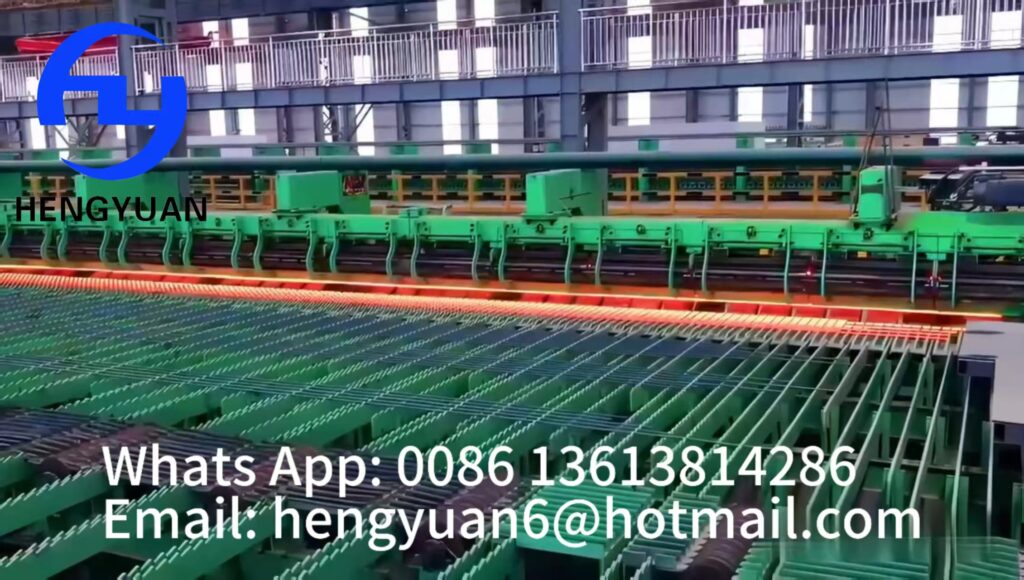
Amid the global shift toward high-quality, low-energy, and intelligent manufacturing in the steel industry, stable capacity, superior quality, and cost control have become critical for enterprises to gain a competitive edge. The 300,000 tons/year high-speed bar rolling production line integrates advanced rolling processes, intelligent control technologies, and high-performance core equipment. Optimized for the full production cycle of ribbed steel bars (Φ8~Φ40 mm), it covers multiple steel grades and full specifications, ensuring large-scale production efficiency while maintaining high precision and stability. This one-stop solution from raw material to finished product serves as a core enabler for production line upgrades, capacity expansion, and quality enhancement.
I. Core Positioning: Meeting Market Demands Across Diverse Scenarios
Designed around the principles of efficiency, precision, reliability, and flexibility, the production line addresses key pain points of traditional rolling operations—including insufficient capacity, poor precision, complex maintenance, and high energy consumption. It is widely applicable to:
- Product Scope: Full-range ribbed steel bars (Φ8~Φ12 mm accounting for 40% of output, Φ14~Φ18 mm for 30%, Φ20~Φ25 mm for 10%, and Φ28~Φ40 mm for 20%), compatible with carbon structural steel, high-quality carbon structural steel, and low-alloy steel grades such as Q235, 45#, 20#, HRB400(E), HRB500(E), and HRB600(E);
- Industry Applications: High-speed wire rod rolling, high-speed bar rolling, conventional bar/wire rod rolling, section steel (angle steel, square steel, flat steel) rolling, combined high-speed bar and wire rod rolling, and special steel (alloy steel, stainless steel, high-strength steel) rolling lines;
- Enterprise Needs: Capacity expansion for medium and small steel mills, technical renovation of aging production lines, layout in high-end steel markets, and green low-carbon production transformation.
The product strictly complies with international standards including GB/T 700-2006, GB/T 591-2018, GB/T 1499.2-2024, GB/T 14981-2009, and GB/T 702-2017. Delivered as straight bars in bundles (2000~3000 kg per bundle) with controlled fixed-length tolerance, it features 4~5 baling points based on length, meeting the stringent requirements of construction, machinery manufacturing, and infrastructure projects for high-quality steel.

II. Core Advantages: Four-Dimensional Breakthroughs to Reshape Production Value
1. High Efficiency & Capacity: Unlocking Scale Benefits with Low Consumption
- Reliable Capacity Output: With an annual designed capacity of 300,000 tons and a yield rate of 97.8%, the line only requires approximately 307,000 tons of 150mm×150mm×12000mm continuous casting billets annually, boasting industry-leading raw material utilization;
- High-Speed Rolling Performance: Equipped with double-stand Φ250 modular mills arranged at a 45° top crossing, the finishing mill operates at an advanced speed in the industry. Supporting 1-5 slitting rolling processes, it increases unit-time output by over 20% compared to traditional lines;
- Continuous Operation Capability: Adopting a 3-shift 2-rotation continuous working system, it achieves a rated annual working time of around 7,200 hours, with a calendar availability rate exceeding 80% and an effective availability rate of approximately 55%. Modular design and high-stability equipment reduce non-production downtime (e.g., roll change, minor maintenance) by 50%, ensuring stable annual capacity release;
- Energy & Resource Efficiency: With unit product energy consumption below the industry average, the line optimizes the use of electricity, water resources, and compressed air, supporting enterprises in achieving green and low-carbon production.
2. Precision Rolling: Ensuring Premium Quality with Multi-Dimensional Control
- Dimensional Accuracy: Roughing, intermediate, and pre-finishing mills adopt high-stiffness short stress line design, with radial adjustment precision of ±0.01mm and axial spherical limit devices. Combined with torsion-free rolling (adjacent stands arranged at 90°), the product achieves IT6-IT7 dimensional accuracy, improving tolerance control by over 30%;
- Surface & Mechanical Properties: Closed-loop controlled rolling and cooling (CRC) technology is applied throughout the process. Pre-water cooling after pre-finishing and post-water cooling after finishing precisely control the temperature of rolled pieces, inhibiting austenite grain growth. This ensures uniform core-surface hardness (difference ≤40HV), rust-free surfaces with a finish of Ra0.8~1.6μm, and stable mechanical properties;
- Full-Cycle Quality Monitoring: Equipped with end-face imaging counting devices (counting error ≤±0.1‰), online dimensional inspection systems, and manual re-inspection links, the line maintains strict quality control from rolling to finished products, resulting in a significantly lower scrap rate than traditional lines;
- Standardized Production: Compliant with international quality standards, the product meets the high requirements of high-end construction, machinery manufacturing, and special engineering, enhancing product added value and market competitiveness.

3. Intelligence & Convenience: Reducing Operational Burden with Automation & Low-Cost Maintenance
- Full-Process Automation: Equipped with Siemens S7-1500 PLC + HMI intelligent control system, it realizes cascade speed adjustment, material tracking, loop height control, and flying shear timing control. Minimizing manual intervention from billet charging to finished product warehousing, it ensures efficient and user-friendly operation;
- High-Performance Drive System: Main mills adopt all-digital DC drives, while auxiliary equipment is paired with high-quality AC frequency converters. Supporting four-quadrant operation and strong overload capacity, the system delivers high transmission efficiency and stable performance;
- Rapid Maintenance Design: The mill body and train frame feature a separate design, with quick-change structures for rolls and stands. Paired with dedicated roll-changing manipulators, roll change time is reduced to 1/3 of that of traditional equipment. Core components (bearings, roll rings) adopt multi-layer sealing and precision lubrication (thin oil, oil-gas, dry oil), extending service life by 2-3 times;
- Low Maintenance Costs: Equipment failure rate is reduced by over 60%, annual maintenance expenses are cut by more than 30%, and spare parts consumption is controllable, significantly lowering enterprise operating costs.
4. Flexibility & Adaptability: Responding to Market Changes with Multi-Steel Compatibility
- Steel Grade & Specification Adaptability: The line can flexibly switch between conventional carbon steel, alloy steel, stainless steel, and high-strength steel production. It supports rapid adjustment of full-range products (Φ8~Φ40 mm) without large-scale equipment modification;
- Production Line Compatibility: Compatible with existing high-speed wire rod, bar, and section steel production lines, it can also serve as core equipment for new lines, adapting to the needs of steel mills of all sizes (capacity expansion for medium and small enterprises, production line upgrades for large enterprises);
- Customized Optimization: Key technical parameters such as roll body length, rolling pressure, and adjustment methods can be customized according to enterprise-specific production scale, steel grade characteristics, and process requirements, achieving over 95% production line matching.
III. Core Equipment Configuration: Building a Solid Foundation with Advanced Technology
1. Rolling Mill System: High-Performance Mills for Precision & Efficiency
- Total Stands: 24, covering roughing, intermediate, pre-finishing, and finishing processes;
- Roughing Mill Group: 4 sets of Φ550 mills + 2 sets of Φ450 short stress line mills, featuring high rigidity and minimal springback to meet the high-strength requirements of initial billet rolling;
- Intermediate Mill Group: 4 sets of Φ450 mills + 2 sets of Φ380 short stress line mills, gradually refining the dimensions of rolled pieces to lay the foundation for precision rolling;
- Pre-Finishing Mill Group: 6 sets of Φ380 short stress line mills, equipped with single-line vertical loops to eliminate speed fluctuation impacts and achieve micro-tension/tension-free rolling;
- Finishing Mill Group: 2 sets of double-stand Φ250 modular mills (arranged at 45° top crossing), with wear-resistant tungsten carbide roll rings and oil film bearings to adapt to high-speed rolling requirements.

2. Key Auxiliary Equipment: Automated Collaboration for Seamless Production
- Flying Shears: 5 sets of high-performance flying shears (crankshaft, rotary, disc types) for head/tail cutting and emergency breaking at different rolling stages. Adapting to various rolling speeds, they ensure high cutting precision and fast response;
- Cooling & Conveying Equipment: 84×9 m step-type cooling bed (for uniform cooling), hub-type steel feeding device (adapting to 16~45 m/s high-speed feeding), and double-channel guide grooves (for rapid conveying), ensuring efficient cooling and transfer of rolled pieces;
- Finishing & Bundling Equipment: 650t cold shear (fixed-length cutting precision ±10mm), automatic counting and separating device, 3 sets of hydraulic automatic bundling machines, and finished product weighing and labeling equipment, realizing full automation of finishing, bundling, and marking;
- Auxiliary Support Systems: 5 sets of high-precision hydraulic systems (NAS 7-8 cleanliness) providing stable power for equipment locking and adjustment; multi-mode lubrication systems matching different equipment operating conditions; and professional water treatment systems ensuring cooling water quality and extending equipment life.
3. Safety & Control Systems: Comprehensive Protection for Stable Operation
- Safety Protection: Equipped with overload protection, limit protection, and emergency stop functions, the line real-time monitors key parameters such as rolling pressure, temperature, and vibration, automatically alarming and shutting down in case of abnormalities. Safety guards are installed in key equipment areas, and the operation interface features safety interlocks to reduce the risk of human error;
- Control Network: Built on Profinet industrial Ethernet, the network enables efficient communication between PLC, drive devices, and remote I/O stations. Supporting remote monitoring and fault diagnosis, it facilitates enterprise remote management and rapid response.

IV. Key Technical & Economic Highlights
The production line excels in capacity efficiency, product quality, and equipment maintenance: achieving a stable annual capacity of 300,000 tons with a 97.8% yield rate, a calendar availability rate exceeding 80%, and a 20%+ increase in unit-time output compared to traditional lines; delivering products with IT6-IT7 dimensional accuracy, Ra0.8~1.6μm surface finish, core-surface hardness difference ≤40HV, and counting error within ±0.1‰; extending core component service life by 2-3 times, reducing failure rate by over 60%, cutting annual maintenance costs by 30%+, and shortening roll change time to 1/3 of traditional equipment—creating comprehensive value for enterprises.
V. Application Scenarios & Value Summary
The 300,000 tons/year high-speed bar rolling production line is more than just a production facility—it is a comprehensive solution for steel enterprises to achieve capacity upgrading, quality improvement, cost optimization, and green transformation. Whether for capacity expansion of medium and small steel mills, technical renovation of aging lines, or high-end steel market layout by large enterprises, it enables rapid market response, reduced operational risks, and enhanced core competitiveness through its efficiency, precision, and intelligence.
In an increasingly competitive market, selecting advanced and reliable production equipment is crucial for sustainable development. With its solid technical foundation and full-process optimization, this production line helps steel enterprises seize opportunities and achieve high-quality development in the industry transformation wave.