
Reinforcing steel bar is the backbone of global infrastructure.
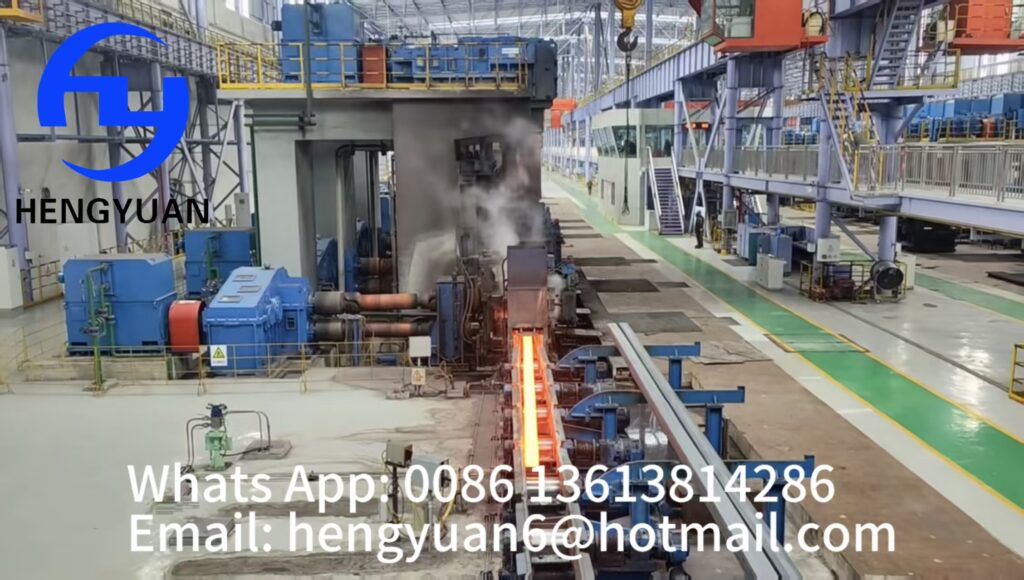
The rolling line is the core of efficient bar production.
A well-designed 300,000-tonne-per-year single-stand high-speed bar rolling line is not merely a combination of machinery, but a fully integrated, intelligent, energy-saving, and reliable industrial system.
As an equipment supplier, we deliver complete solutions that integrate proven processes, high-performance machinery, precision control, and stable auxiliary systems.
1. Line Positioning: Precise Capacity & Full Product Coverage
Designed for an annual output of 300,000 metric tons, the line produces deformed steel bars ranging from Φ8 mm to Φ40 mm, covering carbon structural steel, premium carbon steel, and low-alloy high-strength steel grades. Products fully comply with standards including GB/T 1499.2-2024, GB/T 700, and GB/T 1591, and are delivered in straight bundles weighing 2000–3000 kg with an overall yield rate of 97.8%. This capacity and product mix are highly adaptable for both greenfield projects and upgrades, widely used in construction, bridges, highways, and municipal engineering, ensuring strong market compatibility and fast economic returns.
2. Raw Material & Metal Balance: Data-Driven Efficiency
The line uses 150 mm × 150 mm × 12 m continuous-cast billets with an annual demand of approximately 306,748 metric tons. Oxidation loss is controlled at 0.70%, while crop ends and scrap losses are limited to 1.5%. Uniform raw material specifications simplify billet scheduling, storage, and charging logistics. The optimized metal balance system minimizes material waste in heating, rolling, cutting, and cooling, converting every ton of billet into qualified finished products and directly improving production economy.

3. Production Process: Fully Continuous & Automated Flow
The process follows a closed-loop sequence: billet charging → heating → roughing → No.1 flying shear → intermediate rolling → No.2 flying shear → pre-finishing → pre-cooling → No.3 flying shear → finishing → post-water cooling → high-speed multi-length shear → hub-type laying → cooling bed → cold shear → counting → bundling → weighing → labeling → storage. Every section is tightly integrated through automatic conveying and speed cascading, eliminating redundant handling and manual intervention. Stable rhythm, low fault rates, and high efficiency support reliable long-term operation.
4. Core Equipment: 24 Stands for Stable Productivity
The complete rolling system includes 24 high-rigidity rolling mills: roughing (4 × Φ550 + 2 × Φ450), intermediate (4 × Φ450 + 2 × Φ380), pre-finishing (6 × Φ380), and finishing (2 × double-stand Φ250 45° top-crossing modules). Short-stress-path rolling mills provide high rigidity, precision, fast roll change, and high operating rate. The 45° top-crossing finishing group enables torsion-free rolling with a maximum speed of 45 m/s, greatly boosting output of small-diameter bars. This configuration ensures uniform deformation, stable dimensions, and high-speed performance.
5. Key Systems: Defining Quality & Reliability
5.1 Flying Shear System

Four sets of shears perform head/tail cutting, accident cropping, and high-speed multi-length cutting. The high-speed flying shear operates at up to 43 m/s with clean cuts and accurate length control, protecting equipment and ensuring stable continuous rolling.
5.2 Controlled Rolling & Cooling (CRC)
Pre- and post-finishing closed-loop water cooling systems refine microstructure, control core-surface hardness difference within 40HV, and avoid surface red rust and abnormal phases. This technology enables stable production of HRB400E, HRB500E, HRB600E with reduced alloy addition while meeting national standards.
5.3 High-Speed Laying & Cooling Bed
A hub-type laying device ensures smooth high-speed bar transfer. The 84 m × 9 m step rack cooling bed delivers uniform cooling and straightening. The aligning table ensures consistent bar ends, improving accuracy in subsequent cold shear processing.
5.4 Finishing & Automation
The 650-ton cold shear provides cutting precision of ±10 mm. End-imaging counting delivers accuracy within 0.1‰. Three automatic bundlers ensure tight strapping, while weighing and printing systems complete full-process traceability. The automated finishing line reduces labor and improves product consistency.
6. Hydraulic & Lubrication: Stable Foundation
Five independent hydraulic systems serve the furnace, rolling, high-speed, cooling bed, and workshop areas, with pressure from 15–18 MPa and cleanliness up to NAS 7–8. Lubrication is stratified: four oil circulation systems, three oil-air lubrication units, and six centralized grease lubrication stations. This design reduces wear, extends service life, and lowers downtime.
7. Electrical & Automation: Intelligent Control
The main drives use DC speed control (660V for rough/intermediate/pre-finishing; 750V for finishing). The PLC-based distributed system provides speed cascading, loop control, micro-tension control, bar tracking, jam protection, and HMI monitoring. One-key start, roll change, and recipe setup simplify operation and reduce personnel dependency.

8. Water Treatment: Eco-Efficient & Low Cost
Three circulating water systems (clean, dirty, cooling) achieve a reuse rate of 97.5%, with makeup water of only 0.7 m³ per ton of steel. Classification treatment, filtration, and chemical dosing reduce consumption and discharge, supporting environmental compliance and long-term economy.
9. Key Indicators: Industry-Leading Performance
- Annual operating time: 7,200 hours
- Calendar operating rate: 82.19%
- Effective operating rate: 55.8%
- Power consumption: 120 kWh/ton
- Roll consumption: 0.16 kg/ton
- Tungsten carbide ring consumption: 0.01 kg/ton
All indicators are verified by real projects, offering low consumption, high output, and stability.
10. Our Philosophy as Equipment Supplier
We deliver mature, reliable, fully configured, high-precision, low-energy, easy-maintenance, full-service solutions. We do not pursue unproven technologies or cut corners on specifications. A great rolling line is not about quantity of equipment, but correct matching, optimal layout, and stable performance.
Conclusion
The 300,000 TPY single-stand high-speed bar rolling line represents mature technology, stable performance, high efficiency, and low consumption. It suits most steel plants worldwide for new lines or modernization.
High-quality equipment and systematic solutions produce high-quality reinforcing bars and create sustainable value for steel producers.