
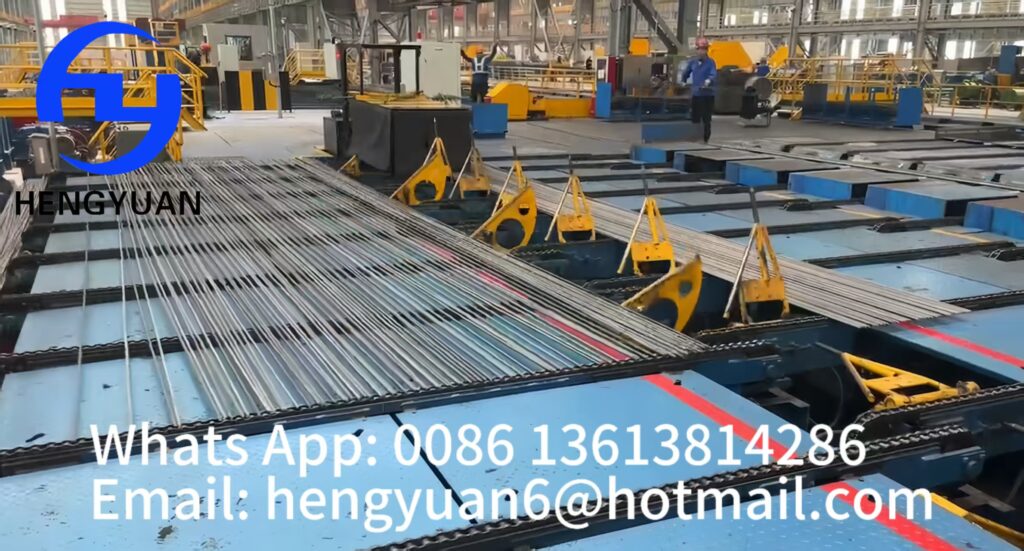
In the steel production industry, the finishing section is often regarded as the “last mile” that determines production efficiency, delivery accuracy, and overall operational cost. For many steel rolling mills, especially those producing deformed steel bars and round bars, manual counting, manual sorting, and manual bundling have long been the standard mode. However, with the increase in labor costs, the improvement of delivery accuracy requirements, and the advancement of intelligent manufacturing, traditional manual operations have gradually exposed fatal shortcomings: high counting error rates, heavy labor intensity, low on-site efficiency, difficulty in data statistics, and potential safety risks in the production process.
Against this background, the automatic bar counting and separating system has become a necessary intelligent upgrade solution for steel rolling enterprises seeking high-quality development. This solution is specially designed for Φ10–Φ40mm deformed steel bars with a fixed length of 12 meters, integrating advanced visual recognition technology, intelligent electrical control, automatic mechanical execution, and digital data management. It realizes the full-process intelligent operation from bar conveying, end alignment, high-precision counting, rapid automatic separation to fixed-quantity bundling, and can be seamlessly connected with the existing rolling production line and chain bed equipment, truly achieving unmanned and intelligent management of the finishing section.

Core Functions That Cover the Whole Production Process
This automatic counting and separating system is equipped with four core functional modules, covering all key links from on-site operation to background management.
First, high-precision automatic counting function. Relying on industrial-grade high-definition visual detection equipment, the system can accurately identify each steel bar in real time, even in the case of slight bending, surface color difference, partial occlusion, and on-site light changes, it can maintain stable recognition. For steel bars with a diameter of Φ10mm and above, the counting error is controlled within 0.01% (one ten-thousandth), which completely meets the strict requirements of factory delivery inspection and fixed-quantity bundling, and completely eliminates the economic losses and customer complaints caused by counting errors.
Second, fast and stable automatic separation function. The system can automatically calculate the number of bars in real time according to the set number per bundle. When the counting reaches the standard, it immediately drives the mechanical execution mechanism to complete rapid separation. For steel bars stacked within 2 layers, the average separation time is ≤ 5 seconds, ensuring the continuity of the production rhythm. At the same time, the separation action is gentle and stable, avoiding bar turnover, overlapping, jamming, and surface damage. In case of serious interweaving and overlapping that cannot be automatically separated, the system will immediately send out an alarm prompt, mark the separation position, and guide manual intervention, effectively avoiding wrong counting and wrong bundling.
Third, convenient remote control function. The equipped human-machine interaction interface supports remote operation and real-time monitoring. Operators can remotely set the number of bars per bundle, start and stop the system, switch working modes, view operating status, and clear data records without frequent on-site operations. This not only reduces the labor intensity of on-site workers but also improves the safety of the working area and keeps the production process orderly and controllable.
Fourth, production management data transmission and storage function. The system automatically records and stores key production data in real time, including shift output, total number of bundles, counting records, production time, alarm information, etc. It supports data export, printing, and can be connected with the factory MES, ERP and other management systems to realize the uploading and sharing of production data. This makes the production process traceable, shift assessment digital, and provides a reliable data foundation for enterprises to realize refined management and production scheduling optimization.

Technical Advantages That Create Core Value
Compared with traditional mechanical counting equipment and pure manual operation, this automatic counting and separating system has obvious technical advantages and brings comprehensive value improvement to enterprises.
In terms of counting stability, the system adopts a visual recognition scheme with anti-interference design. By installing shading devices on the chain bed and optimizing the recognition algorithm, it avoids the interference of external light, dust, and bar surface conditions on the recognition effect. The matching chain bed operation requirements (speed ≤ 600mm/s, stable start and stop, bar end alignment within ±100mm) further ensure the long-term stable operation of the system.
In terms of production efficiency, the system runs synchronously with the rolling line rhythm, eliminating the waiting time caused by manual counting and sorting. The rapid separation action and stable operation state greatly shorten the production cycle of the finishing section, reduce the phenomenon of bar backlog and blockage, and significantly improve the overall operation efficiency of the production line.
In terms of cost reduction, the system can completely replace manual counting and sorting operations, reducing the number of operators in the finishing section and saving a lot of labor costs. At the same time, the system has low energy consumption (counting system 6KW, separation system 3KW), stable performance, low failure rate, and reduces the maintenance cost and production loss caused by equipment failures.
In terms of quality assurance, high-precision counting ensures that the number of each bundle of bars is completely accurate, avoiding delivery disputes and reputation losses. The automatic separation mechanism ensures that the bars are orderly and stable, reducing bending deformation and surface damage, and improving the appearance quality of finished products.
In terms of management upgrading, the automatic collection and transmission of production data replace manual records, making the production data transparent, accurate, and credible. Managers can grasp the production situation in real time, optimize the production plan, and promote the transformation of enterprises from extensive management to refined and digital management.

On-site Adaptation Conditions and Supporting Requirements
To give full play to the best performance of the system, the production site needs to meet certain process and environmental conditions, which are also the conventional transformation requirements for most rolling lines.
In terms of site environment, the roller table alignment baffle needs to be adjusted so that the bar end extends about 350mm beyond the outermost chain of the second-stage chain, and the chain speed of each chain bed is adjustable by frequency conversion. The chain where the counter is installed adopts a flat plate chain or a small-tooth flat plate chain, and a shading device is added to avoid external light interference. At the same time, a stable installation foundation platform needs to be provided according to the specified size.
In terms of electrical configuration, a stable power supply (220±20V, 20A) and standard grounding points need to be provided. The control system needs to receive two PLC contact digital signals (deceleration signal and stop signal) to complete the logic control. The signal cable and power cable shall be laid separately in accordance with the specifications to ensure the stability of signal transmission.
In terms of process operation, the bar ends must be aligned, the end expansion range is controlled within ±100mm, single-row cutting is adopted as far as possible, and the end bending is controlled within the standard range. The stacking height of bars entering the counting area shall not exceed 2 layers, and the chain bed shall start and stop smoothly to avoid bar rushing and rolling. At the same time, strict quality inspection and sorting shall be carried out before the bars enter the counting area to eliminate defective products and ensure the recognition effect.

System Performance Indicators
On the premise of strictly meeting the above on-site transformation and process requirements, the automatic bar counting and separating system can achieve excellent performance indicators:
- Counting accuracy: For bars with a diameter of Φ10mm and above, the counting error ≤ 0.01% (one ten-thousandth).
- Separation speed: For bars stacked within 2 layers, the average end separation time ≤ 5 seconds.
- Alarm function: Automatically alarm for serious overlapping that cannot be separated, and prompt the separation position.
- Bundling setting: Support arbitrary setting of the number of bars per bundle, realizing fixed-quantity metering and bundling.
- Operation stability: Long-term stable operation, adapting to the continuous production rhythm of steel rolling mills.
Conclusion
For modern steel rolling enterprises, the automatic bar counting and separating system is not only a piece of equipment, but also a key solution to solve the pain points of the finishing section, improve production efficiency, reduce operational costs, and upgrade management levels. It completely gets rid of the dependence on manual labor, realizes the intellectualization and automation of the counting and sorting link, and helps steel mills move towards a more efficient, precise, and digital production mode.
Whether it is a new rolling line planning or an existing production line intelligent transformation, this set of automatic counting and separating system can provide stable, reliable, and cost-effective support for the finishing section, allowing production to be more efficient, management to be simpler, and delivery to be more accurate.