
This is a pure technical sharing for steel mill owners, operation directors, maintenance managers and metallurgy engineers.
In the past few years, I have visited many small and medium‑sized steel plants across the globe. Most of them share the same frustrations in molten steel refining:
- Molten steel temperature is unstable → continuous casting waits, interrupts, or even breaks out
- Composition is uneven, inclusions are high → rolling rejects rise, customer complaints increase
- Power consumption is too high → monthly electricity bill becomes a heavy burden
- Electrode wears out too fast → huge extra cost in consumables
- Equipment breaks down often → long downtime, high maintenance labor
- Melting and casting cannot match rhythm → impossible to run multi‑heat continuous casting
These problems are rarely caused by workers alone.
In most cases, they come from unreasonable refining system design, weak structure, poor impedance balance, and low automation.
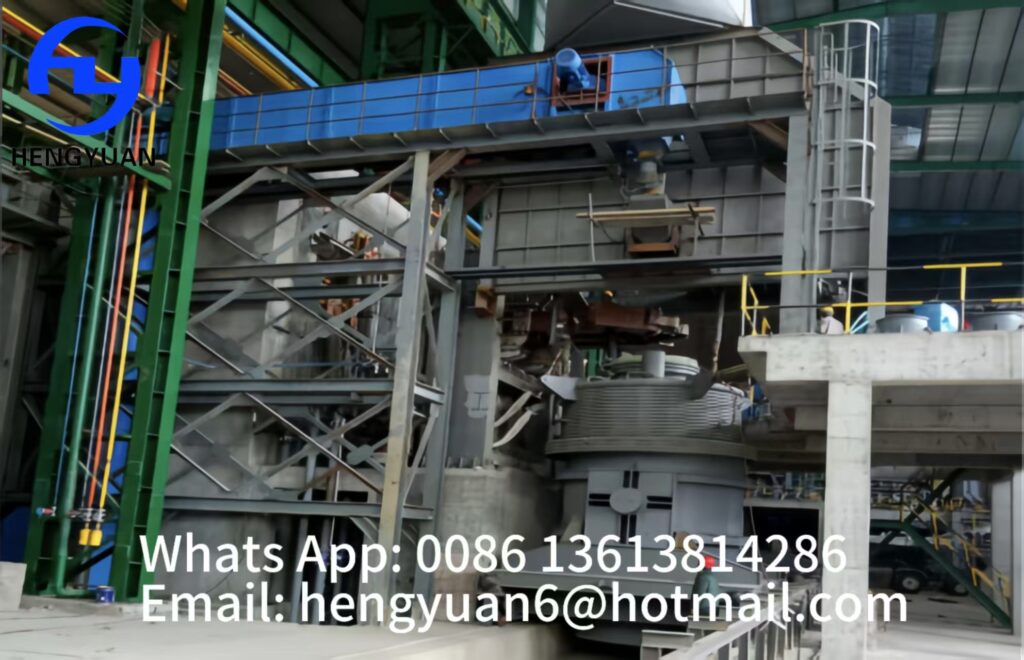
Today I will share a mature, field‑proven solution: LF‑25t three‑arm gantry ladle refining furnace.
No hard sales. No overpromising. Only real technology, real parameters, and real value.
Why Ladle Refining Is a Must in Modern Steelmaking
The LF furnace is not an extra device.
It is the critical buffer and quality guarantee between primary furnace and continuous casting.
Its core value includes:
- Arc heating to precisely compensate temperature for casting
- Bottom argon blowing to homogenize temperature and composition
- Alloy trimming and wire feeding to meet standard requirements
- Remove inclusions and improve steel cleanliness
- Buffer production time to realize stable multi‑heat continuous casting
- Reduce return molten steel and save material cost
In one sentence:
Good refining = stable quality + smooth production + lower cost.

LF‑25t Ladle Refining Furnace — Key Technical Parameters
This is the most widely applied, cost‑effective configuration for 25‑tonne class steel mills.
- Type: Gantry structure, three‑arm design
- Rated capacity: 25 t
- Max treatment capacity: 28 t
- Transformer: 4000 kVA, 35 kV primary, 130–210 V (5‑step off‑load regulation)
- Secondary rated current: 10997 A
- Electrode: Φ250 mm HP graphite electrode
- Electrode control: Hydraulic + PLC automatic adjustment
- Electrode lifting stroke: 2000 mm
- Ladle car: Max load 60 t, VFD 2–20 m/min, positioning ±10 mm
- Argon stirring: Bottom porous plug, max 150 NL/min
- Cooling water flow: 120 m³/h, pressure 0.35–0.5 MPa
- Hydraulic system: 12 MPa, water‑glycol (flame retardant), dual 30 kW pumps
- Three‑phase impedance unbalance: <4%
- Fume extraction volume: ~5000 Nm³/h
- Ladle preheating temperature: >900 ℃
All parameters are verified by hundreds of on‑site applications.
Key Designs That Directly Solve Industry Pain Points
1. Electrode Lifting & Conductive Arm System
- Full water‑cooled copper‑steel composite arms
- Low current density, strong rigidity, good heat dissipation
- Disc spring clamping, hydraulic release
- High‑level insulation treatment to avoid arcing
2. Short Network System

- Large‑section water‑cooled cables and conductive copper tubes
- Flexible compensators to absorb thermal expansion
- Optimized layout for balanced three‑phase impedance
3. Water‑cooled Furnace Cover & Lifting
- Tubular water cooling structure for long service life
- With observation, temperature measurement and sampling holes
- Integrated fume hood for environmental protection
- Hydraulic lifting, stable and no electrode collision
4. Hydraulic System with Safety Design

- Water‑glycol medium (flame‑resistant, safe for steel mills)
- Dual pumps: one working, one standby
- 100L accumulators for emergency lifting
5. Argon Blowing System
- Bottom porous brick for uniform stirring
- Manual flow adjustment: 0–150 NL/min
6. Electrical & Automation Control

- 35 kV high‑voltage distribution with comprehensive protection
- SIEMENS S7‑300 PLC + WINCC monitoring system
- Real‑time display: voltage, current, pressure, temperature, flow
- Fault alarm, history curve, data logging
Real Performance Guarantees (Under Normal Carbon Steel Condition)
- Heating rate: ≥ 4 ℃/min
- Power consumption: ≤ 60 kWh per tonne
- Electrode consumption: ≤ 0.45 kg per tonne steel
- Furnace cover life: > 3000 heats
These are not theoretical data. They are real achievable values on site.
What Value Does This Equipment Really Bring?
- More stable steel quality
- Smoother production rhythm
- Lower daily operating cost
- Higher safety
- Strong compatibility
Closing Thoughts
The global steel industry is becoming more competitive.
The real advantage today is not scale — it’s stability, efficiency and controllable cost.
The refining section is small in the whole production line, but it directly determines your yield, quality and profit.
If you are working on:
- New steelmaking project planning
- Old refining system upgrading
- High energy consumption or quality issues
- Equipment selection and technical comparison
You are welcome to comment below or send me a message.
Let’s share experiences, solve problems, and make steel production more stable and profitable together.