
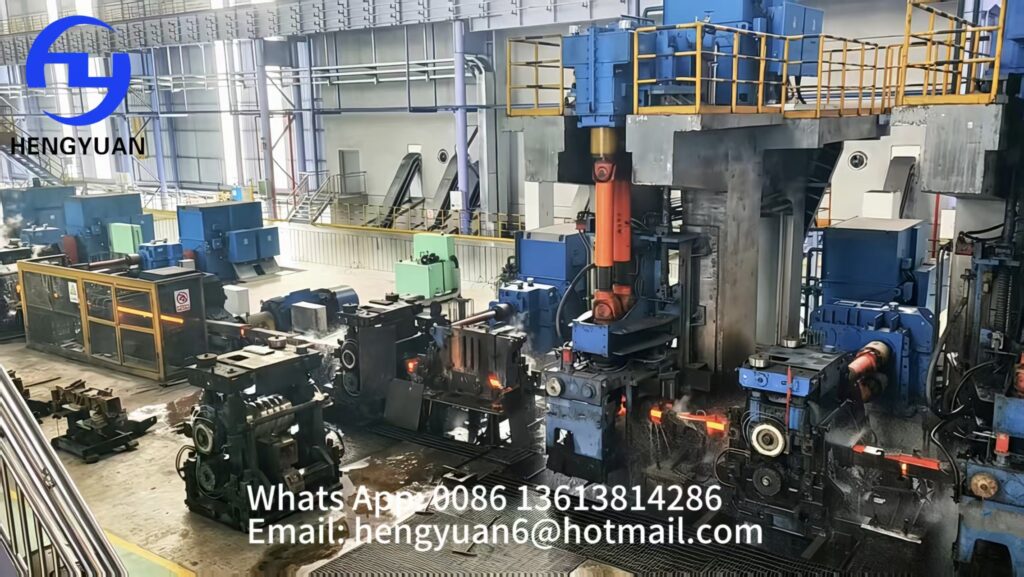
As a supplier with extensive experience in rolling mill technology, I often engage with clients looking to upgrade or establish bar rolling lines. Today, I would like to share a technical overview of a proven 400,000-ton/year high-speed bar rolling mill, focusing on its core process flow, key equipment configuration, automation architecture, and operational performance. This is not a sales pitch, but rather a practical reference for anyone involved in bar mill planning or modernization.
1. Why High-Speed Bar Rolling Mills Remain the Industry Standard
High-speed bar rolling lines are designed to produce Φ8–Φ40mm rebar, round bars, and alloy bars, which serve as critical materials for construction, infrastructure, and engineering projects. Compared to conventional rolling lines, they offer distinct advantages:
- Higher rolling speeds, reaching up to 45 m/s
- Annual capacities ranging from 300,000 to 600,000 tons
- Improved dimensional accuracy and material yield
- Lower energy consumption per ton of steel
- Reduced labor requirements through higher automation
For many steel producers, these lines represent a stable and high-return investment.
2. A Typical Process Flow for a High-Speed Bar Line
A well-designed high-speed bar mill follows a structured, continuous workflow:
- Billet charging and reheating in a walking beam furnace
- Descaling via high-pressure water
- Multi-pass rolling through roughing, intermediate, pre-finishing, and finishing mills
- Thermo-mechanical cooling (TMC) to control bar properties
- High-speed shearing to cut bars to specified lengths
- Cooling on a walking beam cooling bed
- Shearing to final lengths, counting, bundling, weighing, and dispatch
This integrated process ensures consistent quality and minimizes production interruptions.

3. Key Equipment That Defines Mill Performance
The performance of a bar rolling line is determined by its core equipment. Below is a proven configuration:
3.1 Rolling Stands
The line typically includes 24 stands arranged in a continuous sequence:
- Roughing: Φ550 / Φ450 short-stress mills
- Intermediate: Φ450 / Φ380 short-stress mills
- Pre-finishing: Φ380 short-stress mills
- Finishing: Φ250 modular high-speed mills (45° cross configuration)
These stands offer high rigidity, quick roll changes, and precise dimensional control, making them suitable for 24/7 continuous operation.
3.2 Flying Shears
Four flying shears are strategically placed along the line:
- No.1 / No.2 shears for cropping the front and rear ends
- No.3 shear for emergency cutting
- High-speed dividing shear for multi-length cutting
Reliable shears are essential for maintaining rolling rhythm and avoiding cobbles.
3.3 Thermo-Mechanical Cooling System
A closed-loop water cooling system is installed after the finishing mill to control bar temperature and microstructure. This ensures compliance with international standards for HRB400E, HRB500E, and HRB600E grades.
3.4 Cooling Bed and Finishing Line
The walking beam cooling bed ensures uniform cooling and straightness. Automatic counting, bundling, and weighing systems reduce manual labor and improve efficiency.

3.5 Hydraulic and Lubrication Systems
Multiple hydraulic and lubrication stations support the mill’s operation, including roll gap adjustment, locking, and centralized lubrication. These systems are often overlooked but are critical for long-term reliability.
4. Automation and Control: The Brain of the Mill
Modern high-speed bar mills rely on advanced automation to achieve stable and efficient operation:
- Digital DC drive systems for main motors
- Vector control for auxiliary drives
- Speed cascading and loop control
- Tension-free rolling and automatic loop adjustment
- Fault diagnosis, data logging, and process tracking
- HMI-based monitoring and recipe management
These features enable minimal manning levels and reduce the risk of human error.
5. Operational Performance Metrics
From a technical and economic perspective, a well-performing high-speed bar mill delivers consistent results:
- Annual capacity: 400,000 tons
- Material yield: 97.8%
- Power consumption: ~120 kWh/ton
- Water consumption: ~0.7 m³/ton
- Roll consumption: ~0.16 kg/ton
These metrics translate directly into lower production costs and higher profitability.
6. Our Philosophy as an Equipment Supplier
After years of working with steel producers worldwide, our approach remains the same:
- Focus on proven technology rather than overcomplicated designs
- Prioritize reliability and ease of maintenance
- Design solutions that balance performance, cost, and long-term operability
- Provide complete technical support from planning to commissioning
We believe that the best mill is not the most expensive one — but the one that runs steadily and profitably.

7. Closing Thoughts
High-speed bar rolling mills are evolving with trends toward greater efficiency, automation, and sustainability. As an equipment supplier, our goal is to help producers achieve their operational and business objectives through practical, field-proven solutions.
If you are planning a new bar line, upgrading an existing mill, or looking to optimize performance, feel free to connect or leave a comment. I am always open to discussing technical details and project requirements.